
Decision analysis · Measurement
Framing a Decision: The ABS Challenge Research
This case study retells research that Pascal Institute has published, with links to the full articles and their methods below. It is not a client engagement.
The problem
In 2026 Major League Baseball’s Automated Ball-Strike Challenge System let a player ask for a review of an umpire’s call, but only if he chose to, within about two seconds, and at the risk of losing one of his team’s limited challenges. The technology can say whether a call was wrong only after a person decides to ask. Across five articles we treated that moment as a decision problem: what is the opportunity, how often do players act on it, what is acting worth, and how strong does the evidence need to be before acting pays?
Building data we could trust
Public data does not say which calls were wrong, so we reconstructed the ABS zone from public pitch-tracking data and checked it against official challenge results, where it agreed with 9,482 of 9,485 decisions. From 645,793 pitches through September 9, we found 10,755 estimated incorrect called strikes that the batter could legally challenge. Batters challenged 2,112 of them, 19.64 percent, or about one in five. We defined acting on a missed call narrowly, as an observable action, because public data cannot tell us what a hitter saw or believed.
Measuring the recognition gap
A raw rate invites unfair comparisons, so the next two studies asked what drives it. The count mattered more than the pitch. With fewer than two strikes, hitters challenged 16.04 percent of incorrect calls; with two strikes, 48.25 percent, while their challenges of correct calls rose from 1.70 to 13.42 percent. Hitters caught more misses when accepting the call cost more, at lower precision, which points to a decision threshold that moves with the stakes. Adjusting for how recognizable each missed call was then reordered the hitter leaderboard, and a test on later games showed that a hitter’s earlier behavior modestly improved predictions of what he did next. We published the ranks as point estimates with overlapping uncertainty, not as proof that neighboring players differ.
Pricing a challenge
The last two studies put a value on the decision. Correcting an incorrect call was worth about 0.15 expected runs on average, and the most valuable 10 percent of opportunities held about 30 percent of the available value. Saving a challenge has a cost too: after 126 valuable early calls that went unchallenged, a more valuable opportunity appeared later in the same game only 8.7 percent of the time.
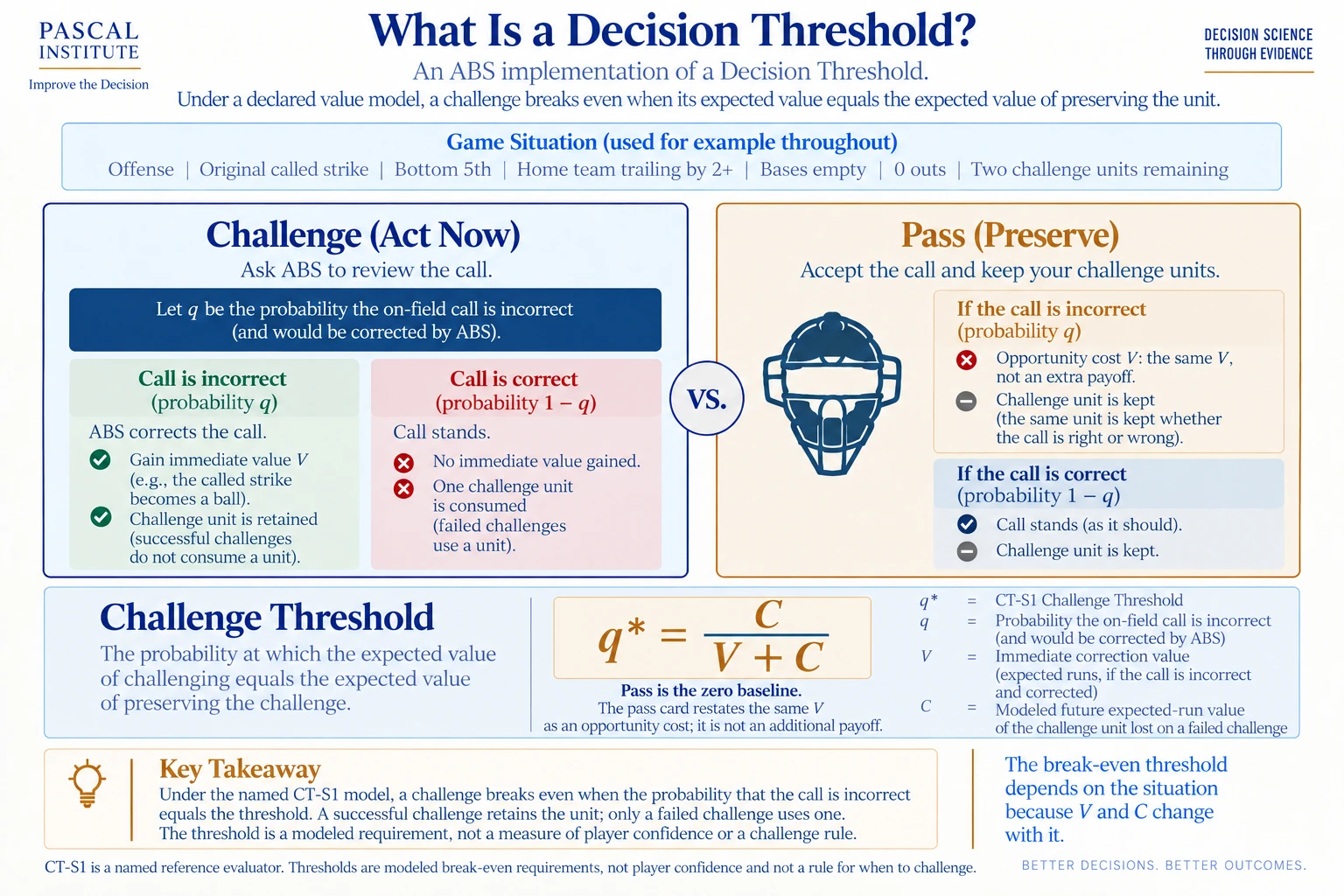
Pricing an ABS Challenge combined the two into a break-even rule. The Challenge Threshold is C divided by V plus C, where V is the value of correcting the call now and C is the value of the challenge a failure gives up. We froze the reference model, CT-S1, and tested it on later games, where the median change was 0.76 percentage points. We also showed that other reasonable assumptions moved the threshold by more than 10 points in about 98 percent of situations, and we published that range beside the reference. The ABS Challenge Opportunity Calculator returns the result for any game situation.
What this means for your organization
Many organizational decisions share this shape: incomplete evidence, a limited resource, a cost for acting wrongly, and a choice about whether to save capacity for a better opportunity that may never arrive. Escalations, audits, appeals and approval queues often work this way. The method carries over. Define the decision and its alternatives, measure how often people act and what drives it, put the immediate gain and the cost of acting on one scale, and find the point where the evidence is strong enough. Then state the assumptions and show how much the answer depends on them, so the people who use it know how far to trust it.