
Major League Baseball's Automated Ball-Strike Challenge System changes the way an umpire's mistake can be corrected, but it does not automatically correct that mistake. The umpire still makes the initial call. ABS enters the process only when an eligible player decides to challenge it.
That creates a second decision that is easy to overlook. A batter who hears strike must decide, within seconds, whether the call was wrong and whether that belief is strong enough to justify using one of his team's limited challenges. The technology can provide an answer, but only after a player decides to ask the question.
Public ABS research already examines challenge frequency, success, missed or expected opportunities, game context, and value. We build on that work with a fixed, independently reconstructed and validated season-scale dataset. Starting with the full population of called strikes, we asked what happened when our reconstructed ABS zone identified an estimated incorrect call.
The central question became simple:
Across our accepted 2026 season-to-date snapshot, batters challenged 2,112 of 10,755 such opportunities. That is 19.64 percent, or roughly one in five.
Following the Call From Pitch to Challenge
Our analysis covers MLB regular-season games from March 25 through September 9, 2026. The fixed dataset contains 645,793 physical pitches. From there, we followed each successive step needed to reach the population we wanted to study: called pitches, called strikes, estimated incorrect called strikes, calls where a legal challenge remained available, and finally the batter's decision to challenge or hold.
The reconstructed zone classified 11,704 called strikes as estimated incorrect calls. Of those, 10,755 occurred while the batter had a legal challenge available. Batters challenged 2,112 and did not challenge 8,643.
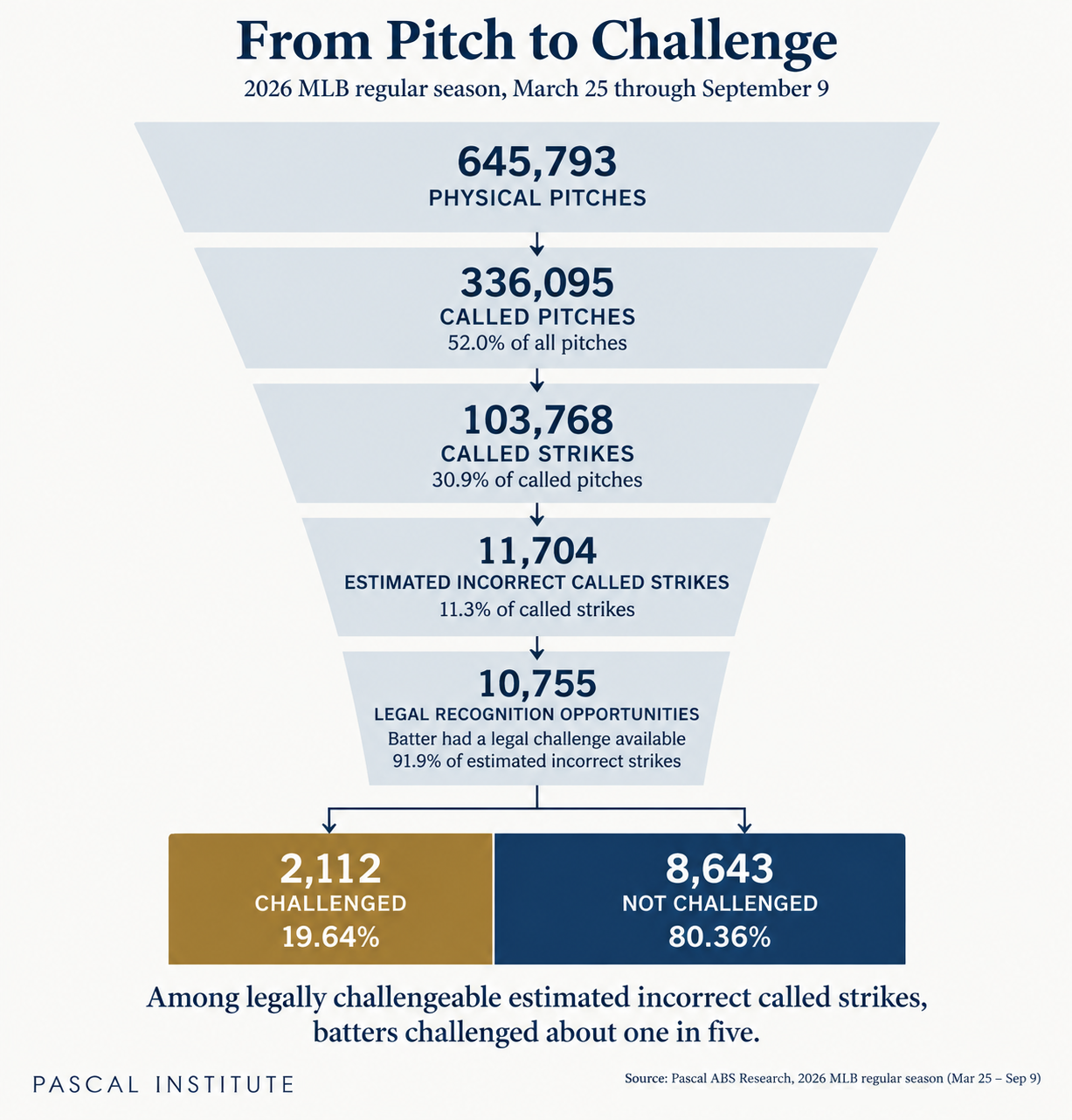
645,793 physical pitches → 336,095 called pitches → 103,768 called strikes → 11,704 estimated incorrect called strikes → 10,755 legal recognition opportunities → 2,112 challenged / 8,643 not challenged.
Throughout this research, we use the word recognition in a deliberately narrow sense. A batter recognized an estimated incorrect called strike when he challenged it while legally able to do so. Recognition describes an observable action. It does not tell us what the hitter saw, what he believed, whether someone in the dugout influenced him, or why he decided not to challenge another pitch.
That distinction also means we should not describe the remaining 8,643 pitches as errors the players "failed to notice." Some may have been. Others may reflect uncertainty, strategy, communication, or factors our data cannot observe. What we know is that the reconstructed zone classified the call as incorrect, a challenge was legally available, and no challenge was made.
How Confident Can We Be in the Reconstruction?
Unchallenged pitches never receive an official ABS decision, so they require an important qualification. MLB did not officially rule those pitches incorrect. They are estimated incorrect calls based on our reconstruction of the 2026 ABS zone using public data.
Before using that reconstruction to study unchallenged pitches, we tested it against the population where an official answer does exist. There were 9,485 official ABS challenges in the accepted snapshot. Our reconstruction agreed with MLB's official decision on 9,482 of them, a 99.968 percent agreement rate.
We preserved and audited the three disagreements rather than removing them. We also repeated the core analysis while progressively excluding pitches very close to the reconstructed boundary. Even after excluding pitches within one-half inch of that boundary, the central finding remained: most legally challengeable estimated incorrect called strikes were not challenged. The recognition rate ranged from 19.64 percent in the accepted population to 22.51 percent under the most conservative boundary exclusion we tested.
That sensitivity test matters because it addresses a reasonable concern about public tracking data. Our conclusion does not depend on treating every pitch a few hundredths of an inch beyond the reconstructed boundary as unquestionably wrong.
Larger Misses Are Challenged More Often
The first factor we examined was the most intuitive one: how far did the pitch miss the reconstructed ABS boundary?
The relationship was clear. As the distance beyond the boundary increased, the probability of a challenge increased as well. That positive association survived every boundary-uncertainty threshold in our publication validation.
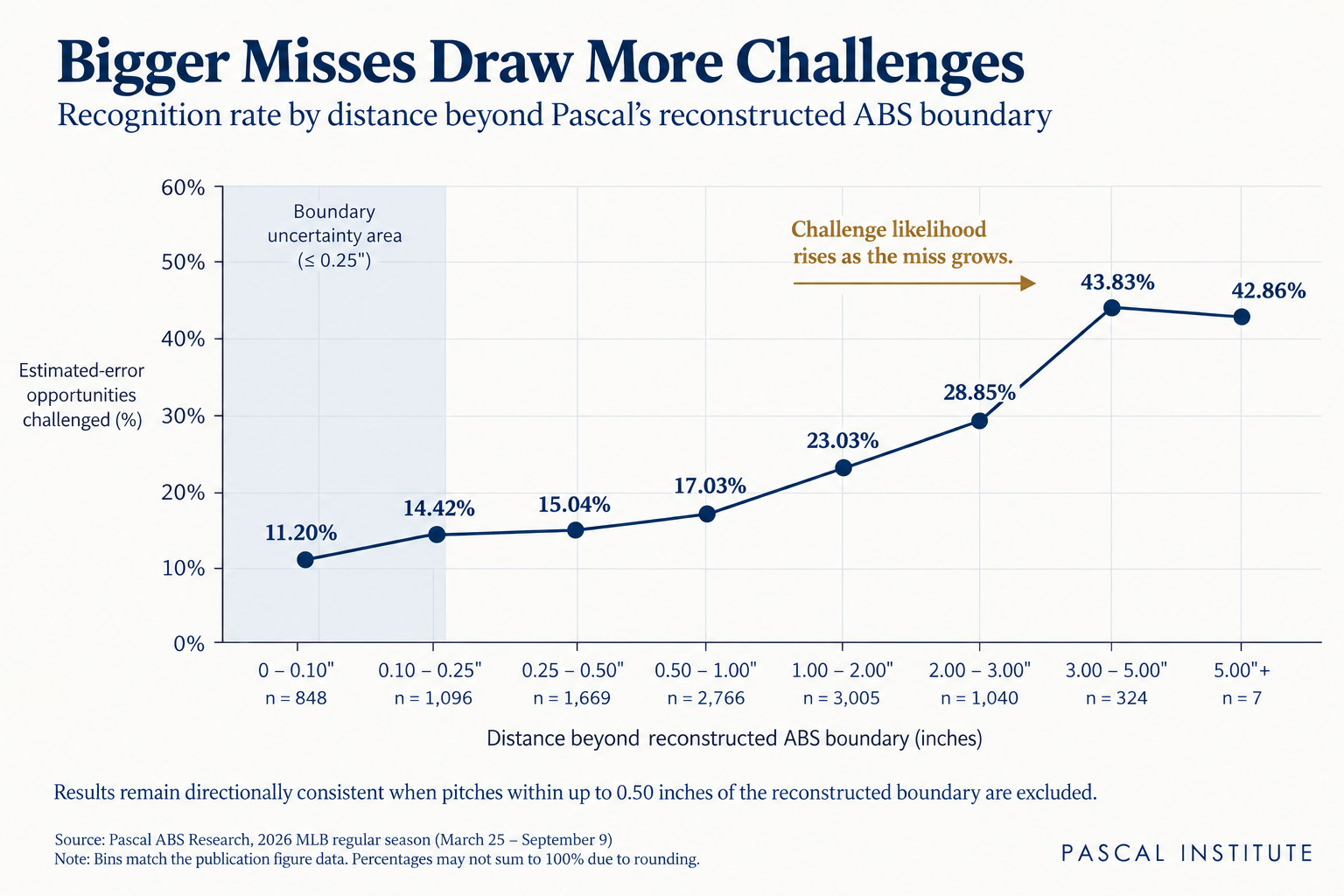
The figure is more useful than a single coefficient because it illustrates the decision hitters actually face. An estimated miss barely outside the boundary presents a different problem from a pitch substantially outside it. The farther the pitch moves into the latter category, the more frequently hitters challenge.
Geometry, however, was only part of the story.
We initially suspected that pitch characteristics might explain additional differences in recognition. A high-velocity fastball, a sweeper moving across the edge, and a breaking ball dropping below the zone create very different experiences for a hitter. We therefore tested pitch type, velocity, horizontal and vertical movement, spin, extension, release position, and handedness.
After accounting for geometry, that group of pitch characteristics did not add validated held-out predictive value in our accepted model. This does not establish that movement or velocity never matters to a hitter. It means something narrower: adding those measured characteristics did not improve our ability to predict future challenge behavior beyond the information already contained in the pitch geometry.
That was not the result we expected when we began the research, but null findings are useful. The purpose of the analysis is to test plausible explanations, not preserve them.
The Situation Matters
Game situation produced a very different result. Adding count, outs, runners, inning, score differential, and remaining challenge inventory substantially improved our ability to predict whether a batter would challenge an estimated incorrect called strike in future months.
That finding helps clarify why ABS is more than a pitch-location problem. Consider two pitches with approximately the same relationship to the ABS boundary. One is called strike in a relatively ordinary early-game count. The other ends a plate appearance in a close game late. The geometric question may be similar, but the consequences of changing the call are not.
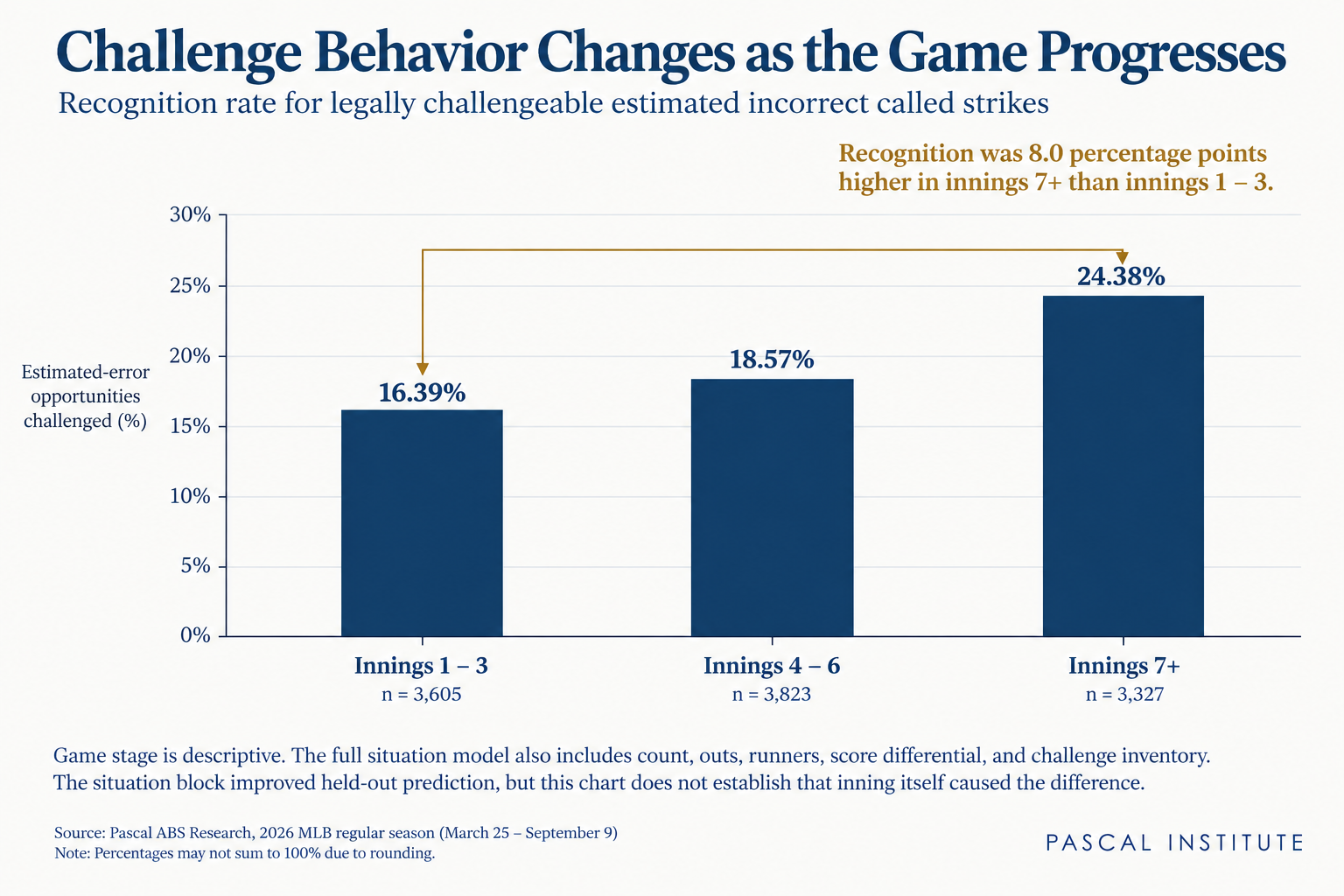
Our results do not establish that players are using those situations optimally. They show that situation contains substantial information about the decision they make. Whether those decisions are good is a separate question, and one that requires us to consider the value of the current call against the future value of preserving the challenge.
That distinction between behavior and decision quality became increasingly important as the project developed.
The Batter Matters
Once we accounted for observable opportunity difficulty, batter identity also improved prediction of future recognition behavior. In other words, information about how a batter had behaved previously helped predict whether he would challenge a later estimated incorrect strike.
We tested that result chronologically. Player information was estimated from earlier games and evaluated against later ones, rather than simply fitting a player effect to the same observations used to measure it. The result persisted strongly enough to support a separate adjusted batter-recognition study.
This still does not tell us that one player has better eyesight or a superior internal sense of the strike zone. We observe the challenge decision, not the private perceptual process behind it. What we can say is that hitters differ in their challenge behavior in ways that remain informative after accounting for the observable difficulty and context of the opportunities they receive.
That will be the subject of the next article in this series.
From Recognition to Decision Quality
The recognition analysis led naturally to a broader question. A challenge is not simply an opportunity to correct a call. It is also a scarce resource. An unsuccessful challenge can reduce the team's ability to act later, while a challenge left unused has no value once the game ends.
That turns ABS into a compact decision problem under uncertainty. The player must consider how likely the call is to be wrong, how much correcting it matters now, and how valuable preserving the challenge might be later.
Our subsequent resource-management research found that challenge exhaustion sometimes preceded later estimated errors that the team could no longer challenge. That finding is descriptive. It does not mean the earlier challenge was a mistake. A good decision can produce an unfortunate outcome, just as a poor decision can occasionally work.
Later in this series, we will examine that distinction directly. The question is not simply whether a challenge succeeded. It is whether challenging was the better decision given what could reasonably have been known at the time.
Building on the ABS Research Already Underway
This study sits within a growing body of public ABS research. Baseball Savant publishes challenge and expected-challenge metrics. MLB and FanGraphs have examined challenge frequency, pitch location, missed opportunities, game context, and run or win value. SABR researchers, ABS Charts, TapToChallenge, and open-source projects have also examined the sequential problem created by limited challenge inventory.
Pascal's contribution is narrower than claiming ownership of those questions. We independently reconstructed and froze a 645,793-pitch 2026 MLB snapshot, validated the reconstruction against 9,485 official decisions, reconciled the full path from physical pitches to legally challengeable estimated errors, and tested geometry, pitch, situation, and batter information using expanding temporal holdouts. Before drafting this article, we also ran a separate publication-validation process designed to challenge our boundary assumptions, terminology, numerical claims, and differentiation from prior work.
That process changed how we describe this research. Some ideas we initially thought might be distinctive already had substantial public work behind them. Some hypotheses we expected to find support for did not survive the data. The resulting claims are narrower, but they are also easier to defend.
What Comes Next
This article begins a continuing audit of how MLB's ABS challenge system moves from umpire call to recognition, challenge decision, resource use, and outcome. The goal is not to turn one dataset into as many conclusions as possible. Each part of that sequence raises a different question, and several deserve their own analysis.
The next installment will focus on batter recognition. Rather than ranking players by challenge success percentage, we will ask which hitters challenge estimated incorrect strikes more or less often than expected given the opportunities they receive. Later articles will examine the relative importance of geometry, pitch characteristics, and situation, followed by the challenge as a scarce resource and the distinction between a good decision and a good outcome.
Those studies eventually lead toward a question that sounds simple but is considerably harder than it first appears:
Challenge success percentage cannot answer that by itself. A complete answer has to consider which errors a player identifies, which opportunities he passes, how much the call matters, and what he gives up by risking a limited challenge.
For now, the first result gives us a useful place to begin. Across 10,755 legally challengeable estimated incorrect called strikes in our accepted 2026 snapshot, batters challenged 2,112.
Methodology
This analysis uses Pascal Institute's accepted 2026 season-to-date ABS research snapshot from March 25 through September 9. The reconstructed decision environment was validated against 9,485 official ABS challenge decisions. Unchallenged pitches never receive an official ABS ruling, so the article uses “estimated incorrect call” for classifications produced by the public-data reconstruction.