
Brandon Pfaadt's line against San Diego looked excellent. He carried a shutout into the seventh inning and Arizona won 5-1. The box score gives us every reason to describe the outing as a success.
But the first inning tells a more complicated story. Several pitches finished far from the catcher's apparent target. Some of those misses still produced favorable results, including a deep fly ball from Fernando Tatis Jr. and a swinging strikeout of Manny Machado.
That distinction matters. If we evaluate a pitch only by what happened after it crossed the plate, we risk confusing outcome with execution. An out can follow a poorly located pitch. A ball can follow a pitch that went almost exactly where it was intended.
Start with the first pitch
Fernando Tatis Jr. opened the game against Pfaadt. The catcher set up on the outside corner. Pfaadt's four-seam fastball instead finished inside and off the plate. Tatis swung and drove the ball 356 feet to left field, where it was caught.
Poor execution, favorable outcome
The scorebook records one out. From a command perspective, however, the pitch was a substantial miss from the apparent target. The favorable result does not erase the location error.
The outcome was even more forgiving than the box score suggests. According to Baseball Savant's park comparison, the same batted ball would have been a home run in three MLB ballparks, including Tatis' home park, Petco Park.
That does not mean the pitch was "almost a home run" in any deterministic sense. Ballpark dimensions are part of the environment in which the game was actually played. But the comparison illustrates how much information disappears when execution is evaluated only by the result.
Video via MLB Film Room. MLB reports a 92.2 mph four-seam fastball, 92.1 mph exit velocity, 28° launch angle and 356-foot hit distance.
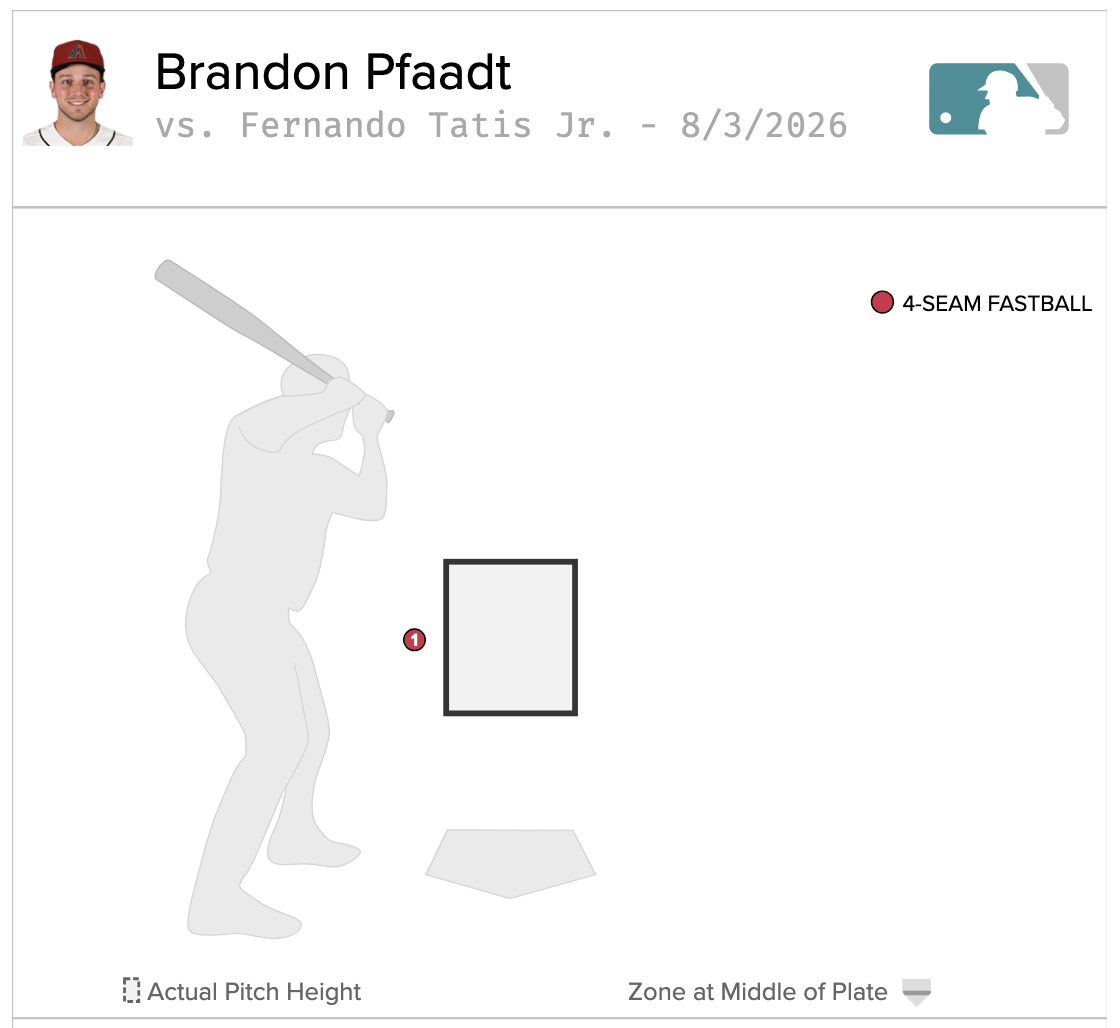
If we looked only at the outcome, the pitch worked. If we looked only at the strike-zone result, we might simply note that Tatis chased a pitch off the plate. Video adds another layer: the ball did not go where the catcher appeared to be asking for it. Batted-ball and park data add still another: the resulting contact was considerably more dangerous than the word flyout communicates.
The inning contains all four combinations
The first inning is useful because it shows how process and outcome can separate in several directions. The same pitcher, within a span of only a few hitters, produces examples of good execution and poor execution, favorable results and unfavorable ones.
Good execution can produce a bad result
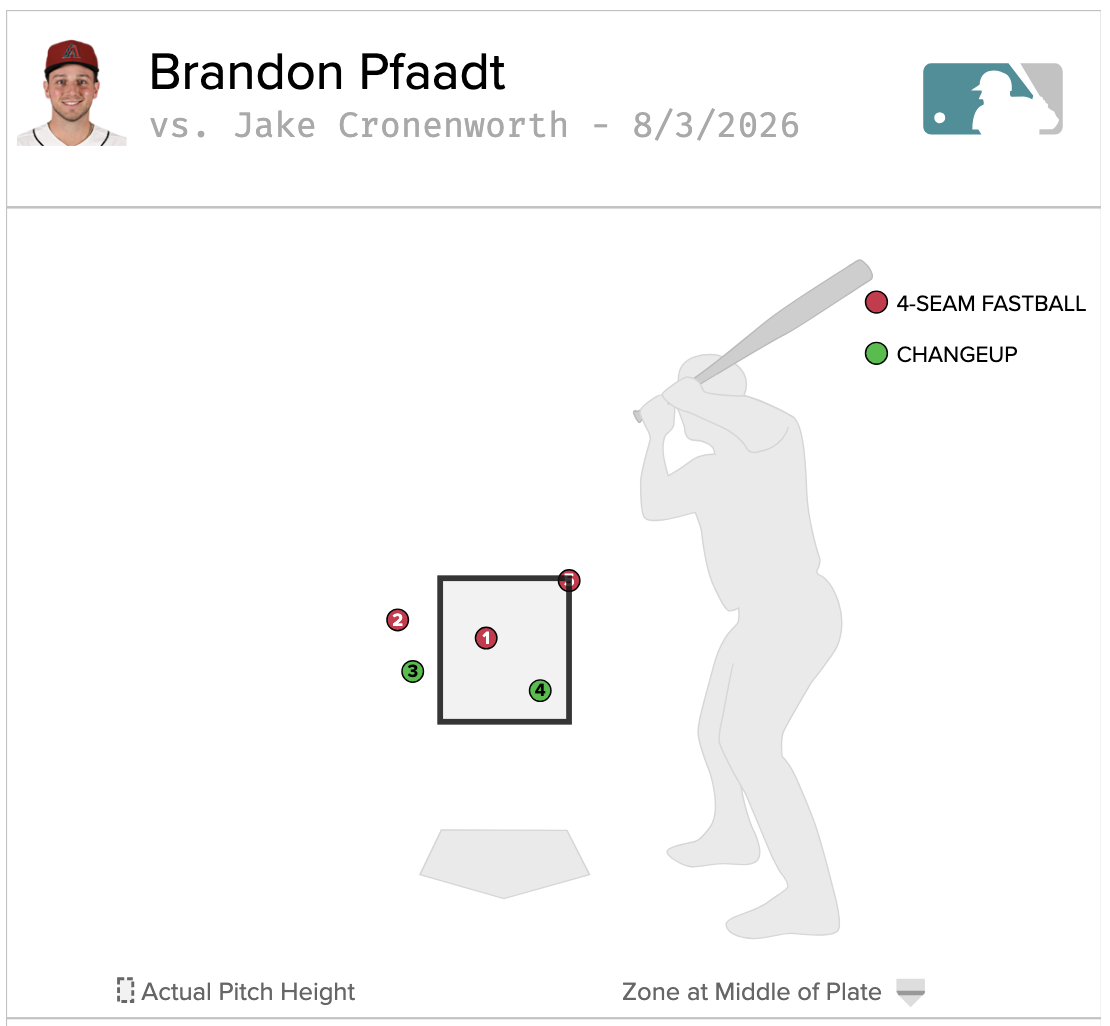
Against Jake Cronenworth, Pfaadt's third pitch provides the opposite lesson from the Tatis flyout. The catcher sets up on the outside corner. The pitch finishes on that edge, just off the plate. It is taken for a ball.
Good execution, unfavorable outcome
The count becomes less favorable, but the location itself is evidence of command. If our only measure is whether the umpire called a strike, we throw away information about how well the pitch was executed.
Video via MLB Film Room.
Sometimes process and outcome agree
Two pitches later, Pfaadt finishes Cronenworth with a fastball on the upper-inside edge, where the catcher is set. This time the execution and the result point in the same direction.
Good execution, favorable outcome
This is the easy evaluation. The target and actual location align, and the result is favorable. The problem is that baseball does not always give us such clean agreement.
Video via MLB Film Room.
The Machado strikeout is the trap
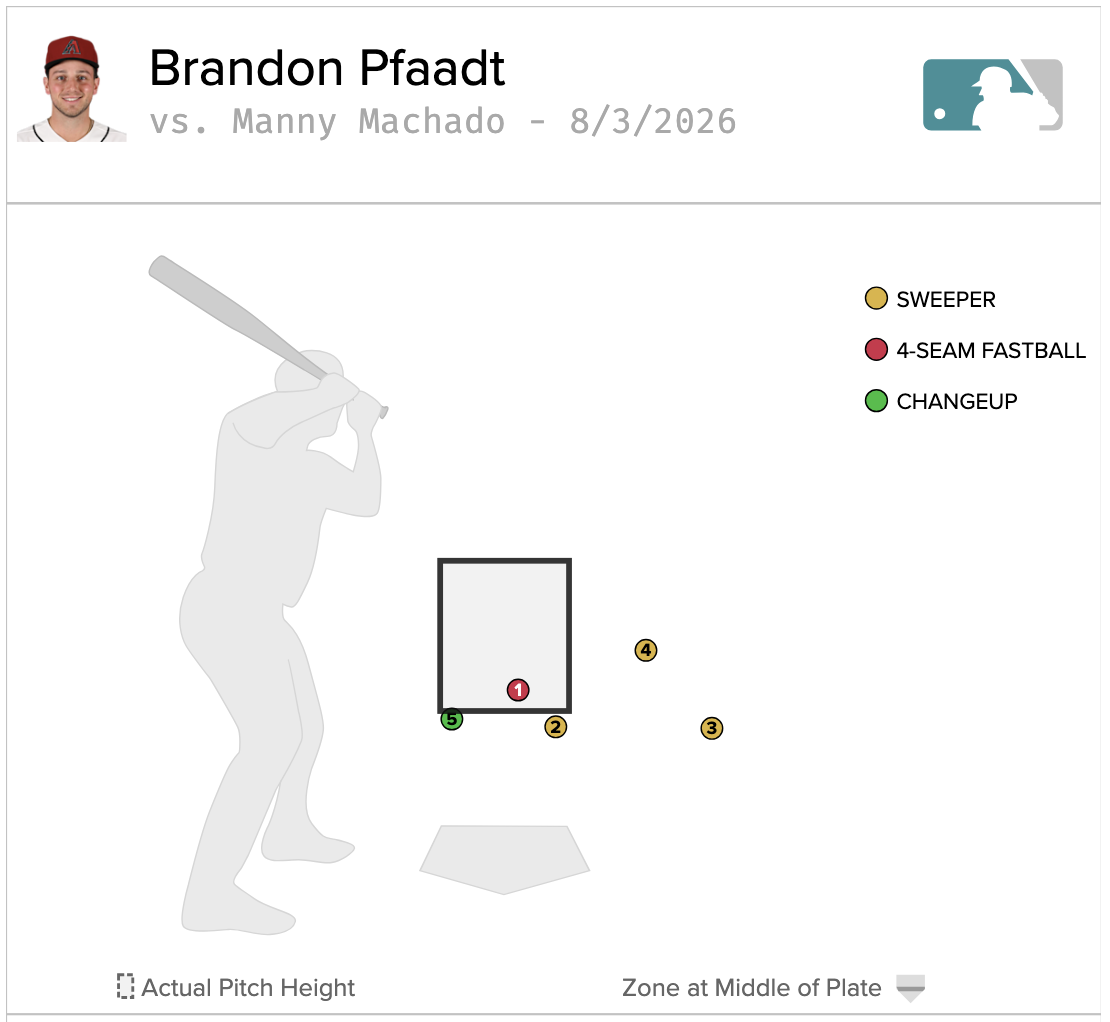
Manny Machado's final pitch is the clearest example of why outcome-based evaluation can mislead. Pfaadt throws a changeup that finishes on the lower-inside corner and produces a swinging strike three. Viewed only by final location and result, it looks excellent.
But the catcher is set on the outside corner.
Excellent result, substantial location miss
The pitch is effective in isolation. It is also substantially different from the apparent target. Both facts can be true. The strikeout tells us what happened. It does not, by itself, tell us whether Pfaadt executed the pitch he intended to throw.
Video via MLB Film Room.
What should we actually conclude?
Not that Pfaadt pitched poorly. His overall line was excellent, and this review considers only the first inning of one start. The point is narrower: the box score cannot tell us everything we want to know about command.
When video is available, target-versus-actual location adds another piece of evidence. Baseball Savant's pitch charts then let us see the location sequence across an entire plate appearance. Together, those sources can distinguish a well-executed pitch that gets a poor result from a poorly executed pitch that happens to work.
That distinction matters beyond pitching. A sound decision can lead to a bad outcome. A poor decision can be rewarded. If we learn only from the result, luck can teach us the wrong lesson.
Review the full inning yourself
The examples above were selected because they illustrate different relationships between process and outcome. The evidence is more useful when readers can inspect the complete sequence rather than only the pitches we chose to discuss.
Tatis · Pitch 1 · In-play out
Cronenworth · Pitch 1 · Called strike
Cronenworth · Pitch 2 · Ball
Cronenworth · Pitch 3 · Ball
Cronenworth · Pitch 5 · Called strike three
Machado · Pitch 1 · Called strike
Machado · Pitch 2 · Swinging strike
Machado · Pitch 3 · Ball
Machado · Pitch 4 · Foul
Machado · Pitch 5 · Swinging strike three
Why video changes the evaluation
Pitch-tracking data tells us where the baseball crossed the plate. Video can help us infer where the catcher expected it to go. Those are different questions.
That makes video especially useful when evaluating command. A strike-zone plot may show a beautiful pitch on the lower-inside edge. The video may show that the catcher was presenting a target away. Conversely, a ball just off the plate may represent excellent execution if that is precisely where the target was set.
Method and limitations
This review treats the catcher's pre-pitch setup and mitt presentation as evidence of the intended target. That is useful, but it is not perfect. Catchers can move late, use deceptive setups, or call pitches whose intended movement path is not fully represented by the initial mitt position. We also do not have access to the club's scouting report, game plan, or private pitch-call information.
Accordingly, this analysis should not be read as a definitive statement of Pfaadt's intent on every pitch. It is a process-review framework: when the video provides a clear apparent target, compare it with the actual location and evaluate that execution separately from the eventual result.
Baseball Savant pitch charts are used as location context, not as proof of intent. The charts show where pitches crossed the plate; the video supplies the evidence used to infer the apparent target.
- MLB Film Room video embeds for the complete first inning against Fernando Tatis Jr., Jake Cronenworth and Manny Machado.
- Baseball Savant game and pitch-location data for San Diego at Arizona, August 3, 2026.