
Decision Science
Better decisions under uncertainty.
Decision Science is the discipline of improving how decisions are made when outcomes cannot be known with certainty.
It brings together data, analytics, forecasting, probability, human judgment, and structured decision-making to move beyond a simple question:
What does the information tell us?
toward a more consequential one:
Given what we know, what should we do?
From Information to Decisions
For decades, organizations have become increasingly capable of collecting data, measuring performance, and building models that predict what may happen next.
Those capabilities are valuable, but they do not make the decision.
A dashboard can tell us what happened. A model can estimate what may happen. A forecast can assign probabilities to possible outcomes. The decision still requires someone to determine what action to take, how much confidence to place in the evidence, what risks are acceptable, and how resources should be allocated.
Decision Science focuses on that final mile between information and action.
Where Decision Science Fits
Decision Science sits at the intersection of Data Science, Business Intelligence, and Behavioral Science.
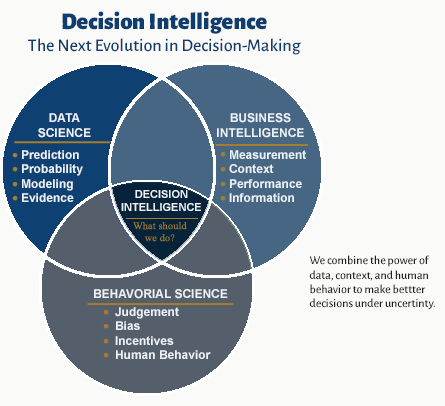
Data Science contributes evidence, modeling, probability, and prediction.
Business Intelligence contributes measurement, context, performance, and an understanding of what has happened.
Behavioral Science contributes an understanding of judgment, incentives, cognitive bias, and how people actually make choices.
Decision Science integrates these capabilities around a practical objective:
What should we do?
Decision Science represents a natural next evolution in data-driven decision-making. The objective is no longer simply to collect more data, create better dashboards, or build more accurate models. The objective is to make better decisions.
Decisions Are Not Outcomes
A good decision can produce a bad outcome. A poor decision can produce a good one.
Uncertainty separates decisions from results.
An investment can lose money despite being supported by sound analysis. A coach can make the statistically correct decision and lose the game. A business can choose the strategy with the highest expected value and still fail. A bettor can identify genuine value and lose the wager.
If we judge decisions only by their outcomes, luck can reward poor processes and punish good ones.
Decision Science therefore evaluates a decision using the evidence, probabilities, alternatives, risks, and information available when the decision was made.
Outcomes still matter. But their greatest value is as evidence for improving what we do next.
Think in Probabilities
Most meaningful decisions are not choices between certainty and uncertainty. They are choices among different uncertain outcomes.
Instead of asking:
Will this happen?
Decision Science asks:
What could happen, how likely is each outcome, and what should we do given those probabilities?
Thinking probabilistically makes uncertainty explicit. It allows forecasts to be evaluated, assumptions to be challenged, risk to be measured, and decisions to reflect degrees of confidence rather than false certainty.
Decisions Require Resource Allocation
Making the right choice is only part of a decision. We must also determine how much to commit to it.
Capital, time, people, attention, and opportunity are limited resources. The strength of the evidence, expected value of the opportunity, uncertainty of the forecast, potential downside, and availability of alternatives should influence how those resources are allocated.
A decision can therefore be directionally correct while still committing too much or too little.
Good decision-making requires both choosing well and allocating well.
The Pascal Approach to Decision Science
Pascal Institute approaches Decision Science as a continuous process rather than a single moment of choice.
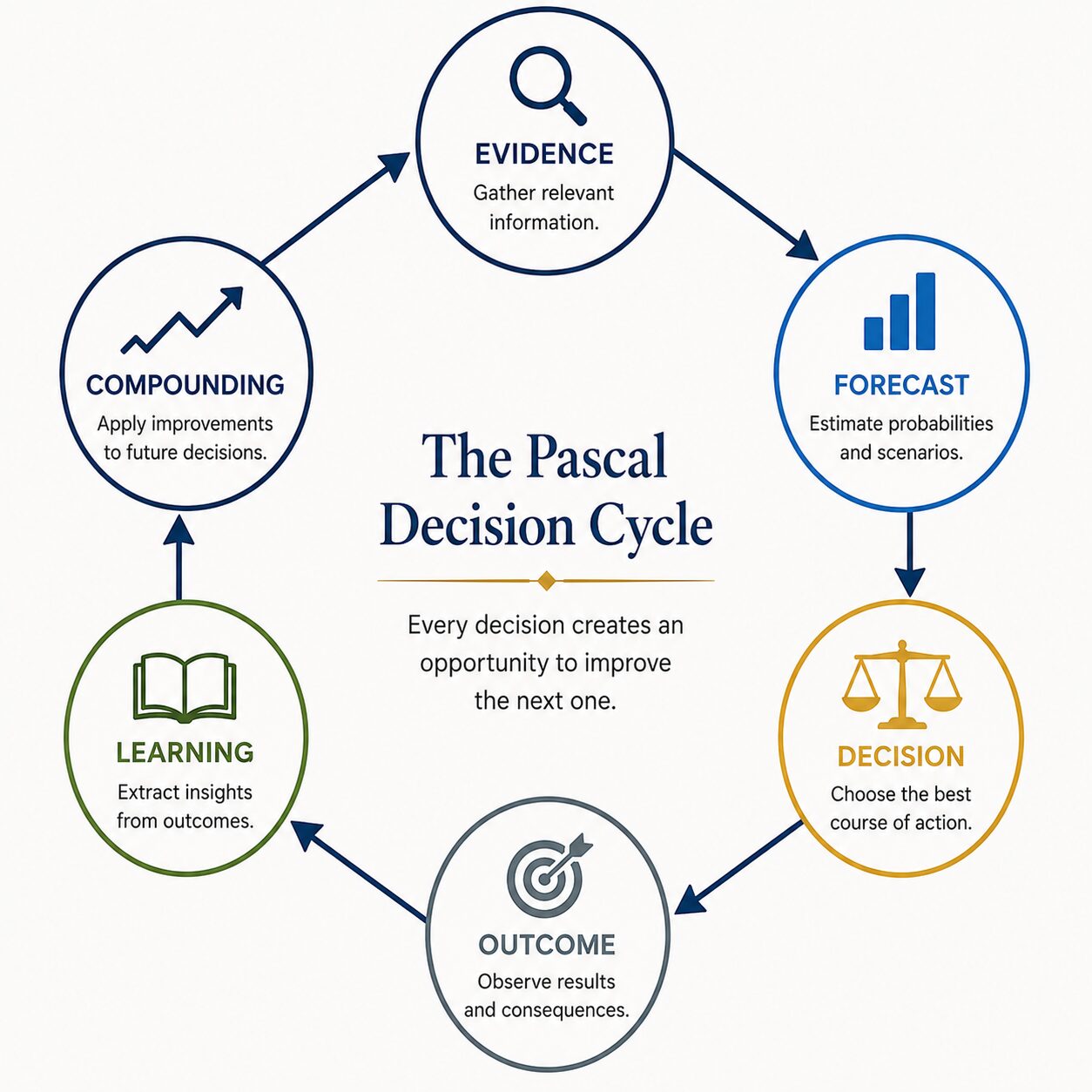
Evidence → Forecast → Decision → Outcome → Learning → Compounding
Gather evidence. Estimate probabilities. Choose an action. Observe what happens. Compare expectations with reality. Learn from the difference. Apply those lessons to future decisions.
Then repeat.
Over time, small improvements in evidence, forecasting, judgment, resource allocation, and learning can accumulate.
Better decisions compound.
Decision Science in Practice
Decision Science is not limited to a particular industry. The underlying principles remain remarkably similar wherever decisions must be made before outcomes are known.
Sports
Use evidence, probability, player evaluation, forecasting, and decision review to improve coaching, roster, and strategic decisions.
Investing
Estimate expected returns, evaluate uncertainty, manage downside, allocate capital, and separate investment quality from short-term results.
Business
Move beyond reporting what happened toward evaluating alternatives, forecasting consequences, allocating resources, and measuring decision quality.
Forecasting & Prediction
Make beliefs explicit as probabilities, track calibration, compare expectations with outcomes, and systematically improve forecasts.
Wagering
Replace outcome-driven thinking with probability, expected value, disciplined capital allocation, and long-term performance measurement.
Improve the Decision
We cannot control every outcome.
We can improve the evidence we gather, the probabilities we estimate, the alternatives we consider, the resources we allocate, and what we learn from the results.
The objective of Decision Science is not perfect prediction. It is a better process for making consequential choices under uncertainty.
And every decision gives us another opportunity to improve the next one.