
About Pascal
Better decisions are built, not predicted.
The Pascal Initiative is a growing effort to improve how people make decisions under uncertainty.
It brings together education, analytics, technology, and community around a simple idea:
We cannot control outcomes, but we can improve the decisions that produce them.
Through research, publicly scored team ratings and forecasts, and AnalytIQ, our modeling app, we explore how evidence, probability, forecasting, behavioral science, disciplined resource allocation, and continuous learning can help individuals and organizations make better decisions.
Pascal Institute, the educational and research arm of the Pascal Initiative, is dedicated to advancing the practical study of Decision Science. Our purpose is not to tell people what to think.
It is to teach better ways to decide.
Improve the Decision.
Why Pascal Exists
Pascal began with a practical problem.
How do you make better decisions when you cannot know what will happen?
The question emerged from work with data, analytics, forecasting, and sports markets, where uncertainty is impossible to ignore. A model might estimate that an outcome has a 48% probability while the market prices it at 40%. The outcome can still lose more often than it wins, yet the difference between those probabilities may represent a meaningful advantage over time.
That leads to a larger realization.
Better prediction alone is not enough.
We have more information than at any point in history. Organizations collect enormous amounts of data. Models make increasingly sophisticated predictions. Markets aggregate information in real time. Artificial intelligence can analyze evidence and generate forecasts at extraordinary speed.
Yet better information does not automatically produce better decisions. Someone still has to decide which evidence matters, how much confidence to place in a forecast, what risks are acceptable, which opportunity offers the greatest value, how much to commit, when new evidence justifies changing course, and what should be learned afterward.
Those questions extend far beyond sports. Investors face them. Businesses face them. Coaches face them. Researchers face them. Individuals face them whenever they commit limited resources to an uncertain future.
The Pascal Initiative grew from the belief that these problems share a common foundation, and that the process of making better decisions can be studied, taught, measured, and improved. We call that process Decision Science.
Our Approach
Pascal Institute begins with a simple premise:
The outcome of a decision and the quality of a decision are not the same thing.
Uncertainty guarantees that good decisions will sometimes produce bad outcomes and poor decisions will sometimes succeed.
If we learn only from whether we won or lost, we risk rewarding bad processes and abandoning good ones.
Instead, we examine what was knowable when the decision was made. What evidence was available? What did we expect to happen? How confident were we? What alternatives existed? What was at risk? How much did we commit? What would have caused us to change course?
Then we examine the outcome, not simply to determine whether we were right, but to identify what the experience can teach us.
This is the foundation of the Pascal Framework.
Explore the Pascal Framework →
What We Believe
Pascal is built around several convictions:
- Transparency over hype. Uncertainty should be acknowledged rather than hidden behind confident predictions.
- Learning over certainty. Being wrong provides information when we are willing to examine why.
- Discipline over emotion. Decisions and resource allocation should follow a process rather than short-term reactions.
- Long-term thinking. Small advantages, and small mistakes, can compound through repetition.
- Community over ego. Better ideas emerge when forecasts, assumptions, and results can be examined and challenged.
The Principles We Teach
Evidence Over Opinion
Begin with the best evidence reasonably available. Distinguish facts from assumptions and confidence from certainty.
Think in Probabilities
The future rarely offers certainty. Estimate what could happen and how likely the meaningful outcomes are.
Decide on Value
The most likely outcome is not necessarily the best opportunity. Consider probability alongside potential reward, downside, cost, and alternatives.
Allocate With Discipline
A good opportunity does not justify unlimited commitment. Capital, time, attention, and other resources should be allocated according to edge, uncertainty, and risk.
Be Willing to Update
New evidence should change decisions when it changes the underlying probabilities. Persistence is valuable only while continuing remains justified.
Learn From Outcomes
Record expectations before outcomes are known. Evaluate the process separately from the result and carry what you learn into the next decision.
Small improvements repeated over time can compound. So can small mistakes.
Learn Through Real Decisions
Decision Science becomes easier to understand when the consequences are real.
That is why Pascal Institute studies decision-making through domains where uncertainty, probability, risk, incentives, and outcomes are visible.
Sports & Wagering
Sports provide an unusually clear laboratory for Decision Science. Probabilities can be estimated, market expectations are observable, decisions repeat frequently, outcomes arrive quickly, and performance can be measured.
A wager can lose while still having positive expected value. A winning wager can have been a poor decision. That makes sports an effective environment for learning to separate process from outcome.
Investing
Investing introduces longer time horizons, portfolio effects, capital allocation, asymmetric outcomes, changing information, and the behavioral difficulty of acting under uncertainty.
The objective is not to predict every market movement. It is to make decisions where expected return justifies risk and allocate capital accordingly.
Business
Organizations continually decide where to allocate scarce resources before knowing the result. Hiring, product development, strategy, pricing, expansion, and investment all require forecasts about uncertain futures.
Decision Science moves analysis beyond what happened? toward the more consequential question:
What should we do next?
Everyday Decisions
The same principles apply whenever we commit scarce resources under uncertainty.
Careers, projects, purchases, education, and other consequential choices all involve evidence, probabilities, alternatives, opportunity costs, and changing information.
The domain changes.
The decision principles remain remarkably similar.
The Pascal Decision Cycle
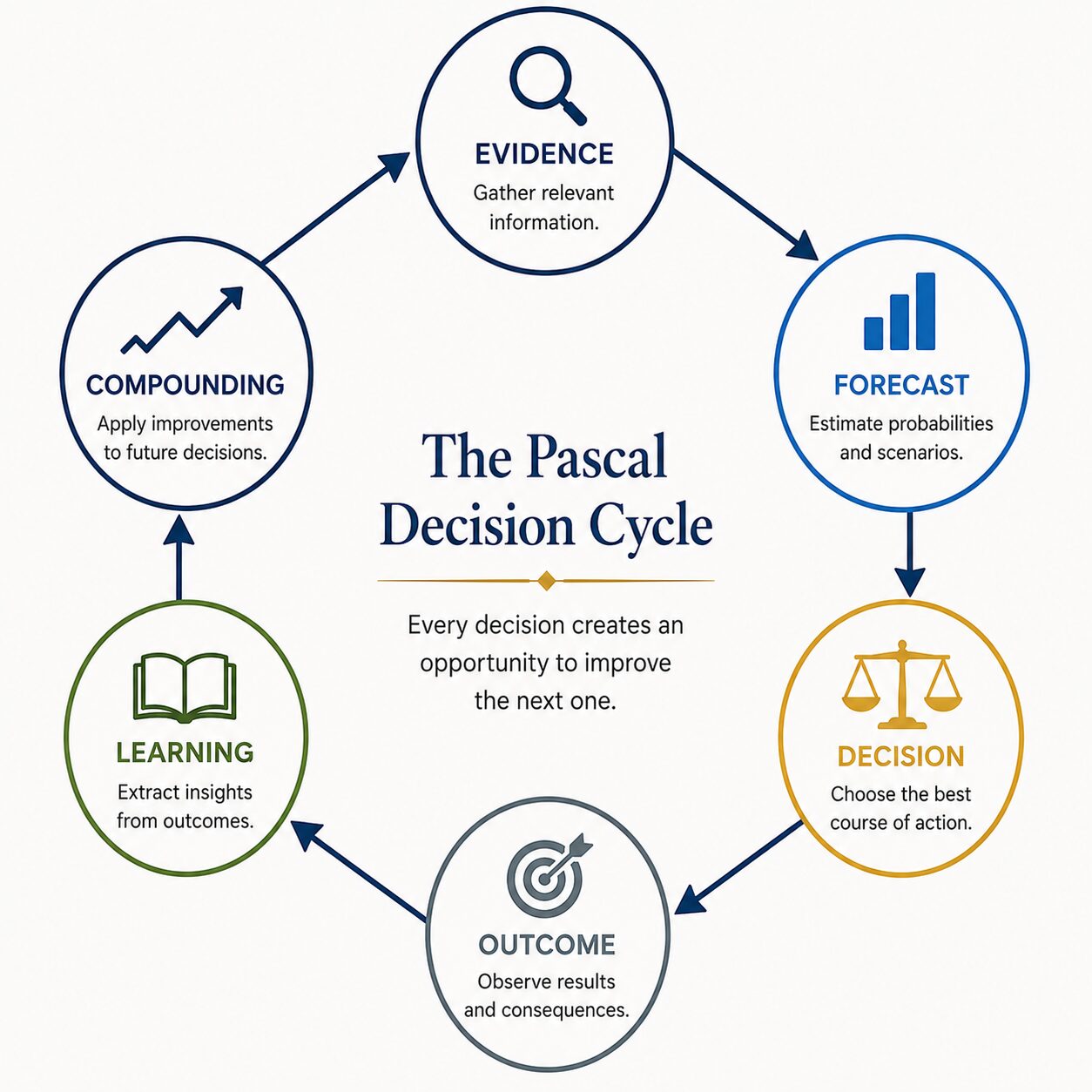
Evidence → Forecast → Decision → Outcome → Learning → Compounding
The Pascal Decision Cycle provides a structure for putting these principles into practice. Each decision produces information that can improve the next one, creating a continuous process of forecasting, deciding, measuring, and learning.
Explore the Pascal Decision Cycle →
How the Work Fits Together
The Pascal Initiative is the organization behind all of this work. It was founded by Christopher Merry and brings Pascal Institute, AnalytIQ, and Pascal Advisory together around Decision Science.
Pascal Institute is the Initiative's educational and research arm, and the name on everything we publish. It publishes the research, guides, and frameworks, along with the public evidence that puts them into practice: the Pascal team ratings, the Power Rankings, and Pick of the Day, with every forecast recorded before the game and scored after it.
AnalytIQ is our modeling app, where members build their own models, test them against past seasons, and track how they perform. Learn about AnalytIQ.
Pascal Advisory is the Initiative's consulting practice. It applies the same methods for organizations: building and validating forecasting and rating systems, and analyzing decisions made under uncertainty. Learn about Pascal Advisory or read the case studies.
Who Is Behind Pascal?
The Pascal Initiative was founded by Christopher Merry, a Decision Scientist and data professional with more than two decades of experience in technology, data engineering, analytics, and applied decision-making.
His career has included work in professional sports data and analytics, along with a master’s degree in Data Science and more than twenty years of practical experience coaching baseball and basketball.
Those experiences exposed the same problem from different perspectives.
Data can tell us what happened. Analytics can identify patterns. Models can estimate what might happen next. But whether evaluating a player, allocating resources, assessing an investment, or choosing between competing strategies, someone still has to decide what to do.
Pascal is an effort to better understand that final step.
Meet Christopher Merry, Chief Decision Scientist →
Why “Pascal”?
The name Pascal connects naturally to Blaise Pascal, whose work helped establish the mathematical foundations of probability.
Probability emerged partly from questions involving games of chance, but its implications became much larger. It gave us a mathematical language for reasoning about uncertain outcomes.
Centuries later, uncertainty remains at the center of investing, forecasting, business, sports, science, and everyday decisions.
Pascal represents that connection:
Use evidence to understand uncertainty, and use that understanding to make better decisions.
Publications & Research
Pascal Institute publishes practical guides, research, case studies, tools, and analysis focused on improving decisions under uncertainty.
Topics include probability and forecasting, expected value, capital management, behavioral bias, decision evaluation, calibration, risk, opportunity cost, knowing when to quit, and learning from outcomes.
The objective is to connect theory with decisions people actually face.
Decision Intelligence: A Practical Guide to Better Decisions Under Uncertainty
An introduction to the principles behind Decision Science and the Pascal approach to improving decision quality.
We Don’t Sell Certainty
We don’t sell certainty. We build better ways to decide under uncertainty.
Pascal Institute does not promise perfect predictions, guaranteed outcomes, winning investments, successful wagers, or decisions without risk.
Those promises are incompatible with uncertainty.
We believe something more useful is possible.
We can improve how evidence is evaluated. We can make uncertainty explicit. We can become better calibrated. We can allocate resources more intelligently. We can recognize when circumstances have changed. We can evaluate decisions without being deceived by outcomes. And we can systematically apply what we learn to the decisions that follow.
The goal is not certainty.
The goal is a better decision process.
What We’re Building Toward
The Pascal Initiative is still early.
The immediate work is publishing team ratings and forecasts that are scored in public, developing the Pascal Framework, publishing Decision Science research, and creating practical resources that demonstrate these ideas through real decisions.
Alongside that work, AnalytIQ gives members a place to build and measure their own models with the same scoring we apply to ours.
The individual projects may evolve.
The objective does not: Improve the Decision.
Follow Our Work
Pascal is being built through research, experimentation, and application. Follow along as we test ideas, publish what we learn, and develop tools for making better decisions under uncertainty.
Continue Learning
Read Our Research & Insights
Start With the Decision Science Starter Guide