
The Pascal Decision Cycle
Every decision creates an opportunity to improve the next one.
Decisions are often treated as isolated events: gather information, make a choice, and see what happens.
The Pascal Decision Cycle treats decision-making differently. Every decision is part of a continuous learning process. Evidence informs a forecast. The forecast informs a decision. The decision produces an outcome. The outcome creates new evidence. What we learn improves the decisions that follow.
The objective is not to make every outcome favorable.
It is to create a decision process capable of improving over time.
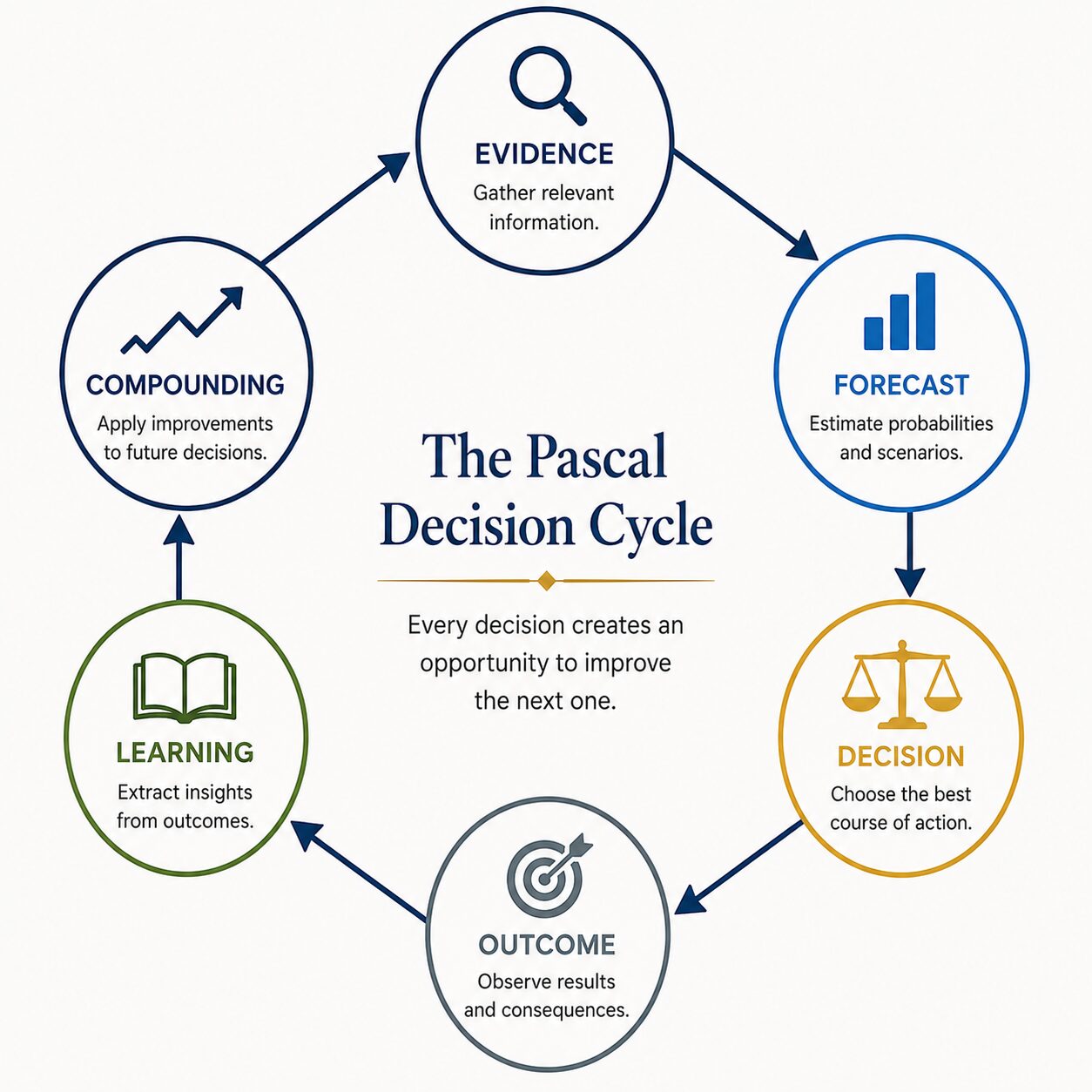
Evidence → Forecast → Decision → Outcome → Learning → Compounding → Evidence
1. Evidence
What do we know?
Every decision begins with evidence.
Evidence may include historical data, observations, research, domain expertise, market information, or other information relevant to the decision. But collecting more information does not automatically improve a decision. Evidence varies in quality, relevance, and reliability.
The objective is to distinguish what we know, what we believe, and what remains uncertain.
Useful questions include:
What information is available?
How reliable is it?
What information might be missing?
What assumptions are we making?
What evidence would change our view?
The goal is not perfect information. Important decisions usually must be made before perfect information is available.
The goal is to begin with the best evidence reasonably available.
Pascal Principle: Evidence over opinion.
2. Forecast
What might happen?
Evidence describes what we know. A forecast translates that evidence into expectations about what may happen next.
Rather than reducing the future to a binary prediction, will happen or will not happen, the Pascal approach expresses uncertainty through probabilities.
Instead of:
The team will win.
Ask:
What probability should we assign to the team winning?
Instead of:
This investment will succeed.
Ask:
What outcomes are plausible, and how likely is each?
This distinction matters because uncertainty does not disappear simply because we make a decision.
A useful forecast makes uncertainty explicit and measurable.
Over time, recorded forecasts can also be tested for calibration. If events assigned a 70% probability occur approximately 70% of the time, we gain evidence that our forecasting process is reasonably calibrated.
Pascal Principle: Forecast with evidence.
3. Decision
What should we do?
A forecast is not a decision.
Knowing that something has a 60% probability of occurring does not tell us whether we should act. We must also consider the potential benefit, downside, cost, alternatives, and resources required.
This is where expected value becomes important.
A less likely outcome can still represent the better decision if the potential return adequately compensates for its probability and risk.
Decision-making therefore asks:
What are my alternatives?
What is the expected value of each?
What happens if I am wrong?
What opportunities am I giving up?
How much should I commit?
That final question matters.
Choosing the right action but committing too many resources can still produce a poor decision. Capital, time, attention, people, and opportunity are finite.
Good decisions require both choosing well and allocating well.
Pascal Principle: Decide with confidence, not certainty.
Decisions Can Change
A decision does not always remain unchanged until an outcome occurs.
New evidence may arrive. Assumptions may fail. Probabilities may change. Better opportunities may emerge.
When that happens, continuing the original course of action is itself another decision.
A good decision yesterday does not obligate you to make the same decision today.
Before making consequential commitments, consider identifying conditions that would cause you to continue, modify, or quit. Establishing those conditions in advance can reduce the influence of sunk costs, emotion, and attachment after resources have already been committed.
That gives us a natural future link:
4. Outcome
What happened?
Eventually, decisions produce outcomes.
This is where one of the most common errors in decision-making occurs:
We confuse the quality of the outcome with the quality of the decision.
A sound decision can produce an unfavorable result. A poor decision can succeed.
Suppose a wager has a genuine 60% probability of winning. Losing the wager does not prove that making it was a mistake. Losing was always expected to happen 40% of the time.
The outcome matters, but it cannot tell us by itself whether the original decision was good.
Instead ask:
Was the decision reasonable given what was known at the time?
Only after answering that question should the outcome become evidence for evaluating the process.
Pascal Principle: Judge the decision before judging the result.
5. Learning
What should change?
An outcome becomes valuable when we learn from it.
Compare what happened with what was expected.
Was important evidence missing? Were assumptions incorrect? Was the forecast poorly calibrated? Did we underestimate a risk? Was the resource allocation inappropriate?
Or was the process sound and randomness simply produced an unfavorable outcome?
The purpose is not to construct a story explaining why the result was inevitable after we already know what happened.
The purpose is to identify information that would have improved the decision before the outcome was known.
This is why decision journals, recorded forecasts, and pre-decision assumptions are valuable. They preserve what we actually believed before hindsight had an opportunity to rewrite it.
Pascal Principle: Learning over certainty.
6. Compounding
How does this improve the next decision?
Learning completes one decision while beginning another.
What we discover becomes evidence for the next cycle.
A slightly better understanding of the evidence can improve a forecast. A better forecast can improve a decision. Better allocation can preserve resources. Better outcome analysis can improve learning.
None of those improvements needs to be dramatic.
Their power comes from repetition.
Small improvements in decision quality, repeated over time, can compound.
The inverse matters just as much.
Poor assumptions, overconfidence, bad resource allocation, refusal to change course, and learning the wrong lessons from outcomes can also repeat.
Poor decisions compound too.
That is why the objective is not simply to win the next decision.
It is to build a process that becomes progressively better at making them.
Pascal Principle: Compound with discipline.
One Cycle Becomes the Next
Evidence → Forecast → Decision → Outcome → Learning → Compounding ↻
The cycle does not truly end at Compounding.
Learning changes the evidence available for the next decision. Experience changes our assumptions. Recorded forecasts reveal calibration. Outcomes expose weaknesses in our models. New information changes our understanding.
The next cycle therefore begins from a different place than the last.
That is the purpose of the framework.
Every decision creates an opportunity to improve the next one.
Put the Cycle Into Practice
Before your next consequential decision, record:
Evidence: What do I know, and what am I assuming?
Forecast: What outcomes are possible, and what probabilities would I assign?
Decision: What am I choosing, why, and how much am I committing?
Adaptation: What new information would cause me to change course?
Outcome: What actually happened?
Learning: What did I get right or wrong about the process?
Compounding: What will I carry into the next decision?
Improve the Decision.
You cannot control the outcome.
You can improve the evidence you gather, the forecasts you make, the resources you allocate, your willingness to adapt, and what you learn from the result.
Then do it again.