
Know When to Quit
A good decision yesterday does not obligate you to make the same decision today.
We are taught to value persistence.
Finish what you start. Don’t give up. Stay the course.
Persistence can be valuable, but only while continuing remains the better decision.
When circumstances change, new evidence emerges, or the probability of success declines, persistence can become costly. Time, capital, attention, and opportunity continue flowing toward something simply because we have already committed to it.
Decision Science asks a different question:
If I were making this decision today, knowing what I know now, would I make the same choice?
If the answer is no, continuing deserves scrutiny.
The Decision Has Changed
Imagine investing $10,000 in a company because your analysis suggests a 65% probability that its new product will succeed.
The decision may be entirely reasonable.
Three months later, a major competitor introduces a superior product. Early sales disappoint. Management lowers its forecast. Based on the new evidence, you now estimate the probability of success at only 30%.
Your original decision does not become wrong simply because circumstances changed.
But you now face a new decision.
The relevant question is no longer:
Was investing $10,000 a good decision?
It is:
Given the evidence available today, is continuing to hold this investment the best use of the resources I still control?
The $10,000 already invested cannot be changed.
What happens next can.
Sunk Costs Are Not Future Value
Once we invest money, time, effort, or identity into something, abandoning it becomes psychologically difficult.
We think:
I’ve already spent $20,000 on this project.
I’ve already spent two years building this business.
We’ve already invested too much to stop now.
I’ve come too far to quit.
Those statements describe the past.
The decision concerns the future.
Money already spent should not make an otherwise unattractive opportunity more attractive. Time already invested cannot be recovered by investing additional time. Continuing only makes sense when the expected future value of continuing exceeds the alternatives available now.
This creates one of the most useful questions in the Pascal Framework:
If I had not already invested anything, would I choose to invest in this opportunity today?
If not, the resources already spent may be influencing the decision more than the opportunity that remains.
Quitting Can Feel Like Losing
Quitting often forces us to acknowledge a loss.
Selling an investment makes the loss visible. Ending a project means accepting that the resources already invested may never produce the expected return. Changing strategy can feel like admitting the original strategy failed.
Continuing postpones that recognition.
That creates a dangerous asymmetry: the desire to avoid accepting yesterday’s loss can cause us to create a larger loss tomorrow.
Decision Science requires separating those two questions.
What happened to the resources already committed?
and
Where should the resources I still control go next?
Only the second question can still be acted upon.
Opportunity Cost Makes Continuing a Decision
Doing nothing can feel passive.
It isn’t.
Every resource that remains committed to one opportunity is unavailable for another.
A business continuing an underperforming project is choosing not to deploy those employees and capital elsewhere. An investor holding one position is choosing not to invest that capital in another. A coach leaving a struggling pitcher in the game is choosing not to use another pitcher.
Even attention has an opportunity cost.
So the choice is rarely:
Continue or quit.
The better comparison is:
Continue versus the best available alternative.
That changes quitting from an emotional judgment about the past into a resource-allocation decision about the future.
Decide When to Quit Before You Need To
In Quit: The Power of Knowing When to Walk Away, Duke argues for establishing conditions for quitting before we are caught inside the decision.
The principle fits naturally into the Pascal Framework.
When making an important decision, don’t record only why you are proceeding.
Also record:
What would have to happen for me to change my mind?
These conditions can be established in advance.
For an investment:
Sell if the assumptions underlying the investment thesis no longer hold.
For a business initiative:
Reevaluate if customer adoption remains below the agreed threshold after six months.
For a sports model:
Reevaluate the model if out-of-sample calibration or expected-value performance falls outside predefined limits.
For a coach:
Change pitchers if velocity drops materially, command deteriorates, or predefined workload limits are reached.
The specific criteria vary. The principle does not.
Define the conditions while you are still capable of evaluating them objectively.
Quit Criteria Are Evidence, Not Automatic Commands
A predefined threshold should not necessarily become an automatic instruction to quit.
Circumstances may have changed in ways that make the original threshold obsolete. New evidence may justify continuing despite reaching it.
The purpose of a quit criterion is to trigger reconsideration, not replace judgment.
When a threshold is reached:
Review the evidence → Update the forecast → Compare the alternatives → Decide again.
This prevents us from replacing one rigid decision rule with another.
Quitting Belongs Inside the Decision Cycle
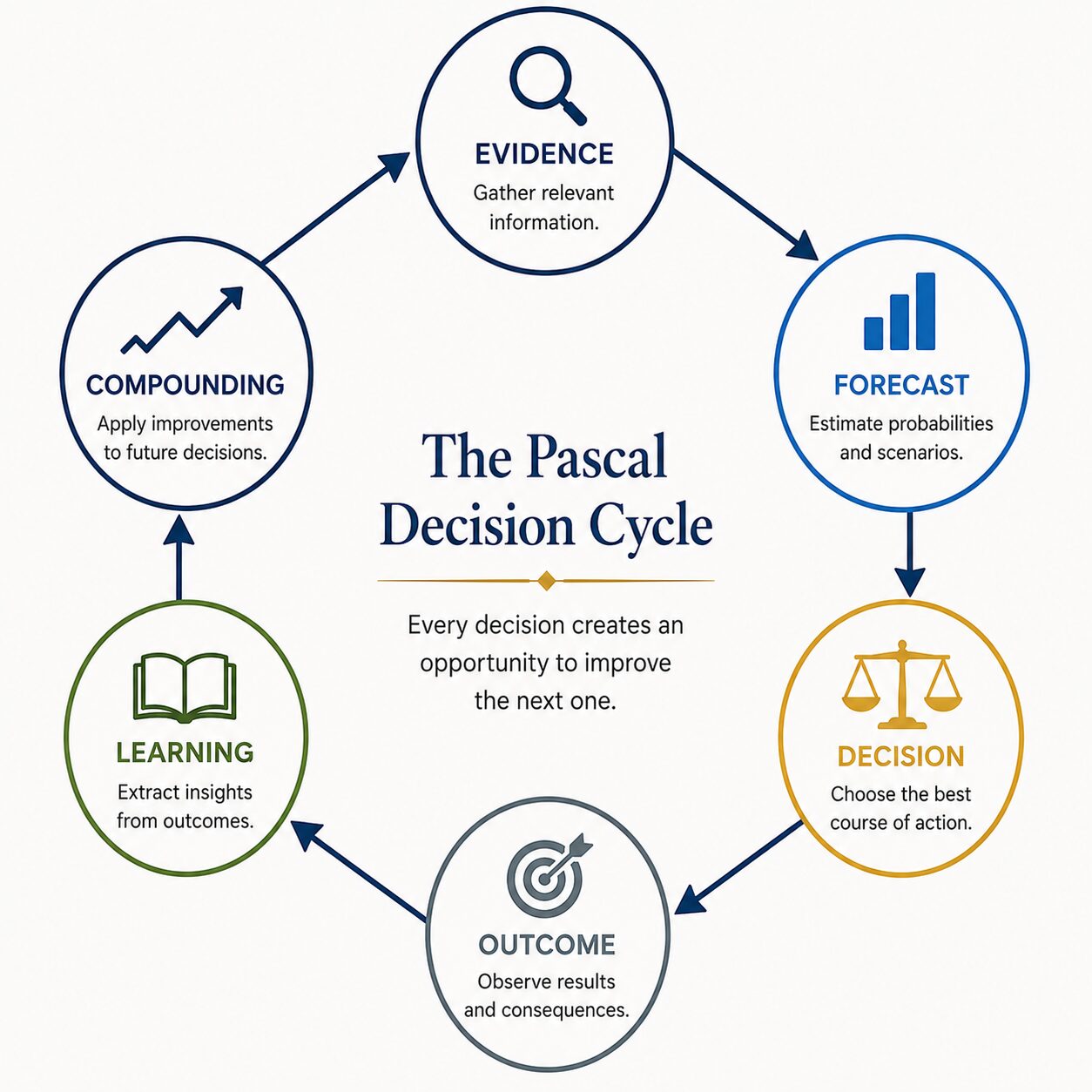
Evidence → Forecast → Decision → Outcome → Learning → Compounding
Not every decision proceeds uninterrupted from Decision to Outcome.
New evidence can arrive while the decision is still unfolding.
When it does:
New Evidence → Updated Forecast → Continue / Modify / Quit
That is not a failure of the original decision process.
It is the decision process working.
A good decision-maker should be willing to change course when the evidence supporting the original decision changes.
Quitting Is Not the Opposite of Persistence
The objective is not to quit sooner.
It is not to persist longer.
It is to distinguish between persistence that still has positive expected value and persistence driven by sunk costs, loss aversion, ego, or habit.
Sometimes discipline means continuing through temporary setbacks.
Sometimes discipline means walking away.
The difficult part is determining which situation you are in.
The Pascal Question
Before continuing a significant commitment, ask:
Knowing what I know today, if I were not already committed, would I choose this again?
If yes, continuing may be justified.
If no, don’t let yesterday’s decision make today’s decision for you.