
Explore the Pascal Framework
A practical system for making better decisions under uncertainty.
Decision Science provides the discipline. The Pascal Framework provides a practical approach for applying it.
The framework begins with a simple premise: we cannot control outcomes, but we can improve the process that produces our decisions. That means improving the evidence we use, the probabilities we assign, the choices we make, the resources we commit, and what we learn afterward.
The objective is not to be right every time.
The objective is to improve the decision.
1. Start With Evidence
Every decision begins with an understanding of what is known, what is uncertain, and what information can reasonably be trusted.
More information is not necessarily better information. Evidence must be relevant, timely, reliable, and evaluated in context.
The Pascal approach favors evidence over opinion, while recognizing that evidence is rarely complete.
The question is not:
Do I have enough information to be certain?
It is:
Do I have the best evidence reasonably available for this decision?
2. Think in Probabilities
Evidence does not usually produce certainty. It changes what we should believe about possible outcomes.
Instead of asking whether something will happen, the Pascal Framework asks what could happen and how likely each meaningful outcome appears to be.
A 70% forecast is not a prediction that must come true. It is a statement about uncertainty. If forecasts assigned 70% probabilities are well calibrated, they should fail roughly 30% of the time.
Thinking probabilistically allows uncertainty to become part of the decision rather than something we pretend does not exist.
Forecast with evidence.
3. Decide on Value, Not Certainty
The most likely outcome is not always the best opportunity.
A team with only a 48% chance of winning can represent an attractive wager if the market price implies only a 40% probability. An investment with a substantial chance of failure may still be worthwhile if the potential return adequately compensates for the risk.
Decision quality therefore depends on the relationship between:
Probability × Consequence × Cost × Alternatives
not merely which outcome is most likely.
Decide with confidence, not certainty.
4. Size the Commitment
Identifying a good opportunity does not answer how much should be committed to it.
Every decision consumes scarce resources: money, time, attention, people, reputation, or opportunity. The amount committed should reflect the strength of the evidence, expected value, uncertainty, downside risk, and available alternatives.
This creates two separate questions:
Should we act?
and
How much should we commit?
A decision can be correct in direction and still be poor in sizing.
5. Update When the Evidence Changes
A decision is made using the information available at a particular moment. New information can change the probabilities that justified it.
Continuing a decision simply because resources have already been committed confuses past costs with future value.
The Pascal Framework therefore treats continue, modify, and quit as decisions themselves.
A good decision yesterday does not obligate you to make the same decision today.
Before committing to consequential decisions, identify conditions that would cause the decision to be reconsidered. Doing so before emotions, sunk costs, and outcomes become involved makes it easier to respond rationally when those conditions occur.
6. Judge the Decision, Then Learn From the Outcome
Outcomes matter, but they are not the same thing as decision quality.
A favorable outcome can follow a poor process. An unfavorable outcome can follow a sound one.
The Pascal Framework therefore evaluates a decision using what was reasonably knowable before the outcome occurred.
Then the outcome becomes evidence.
What happened? What differed from the forecast? Were important variables missed? Were the probabilities poorly calibrated? Did randomness simply produce one of the less likely outcomes?
The purpose of reviewing an outcome is not to rewrite the past.
It is to improve the next decision.
The Pascal Decision Cycle
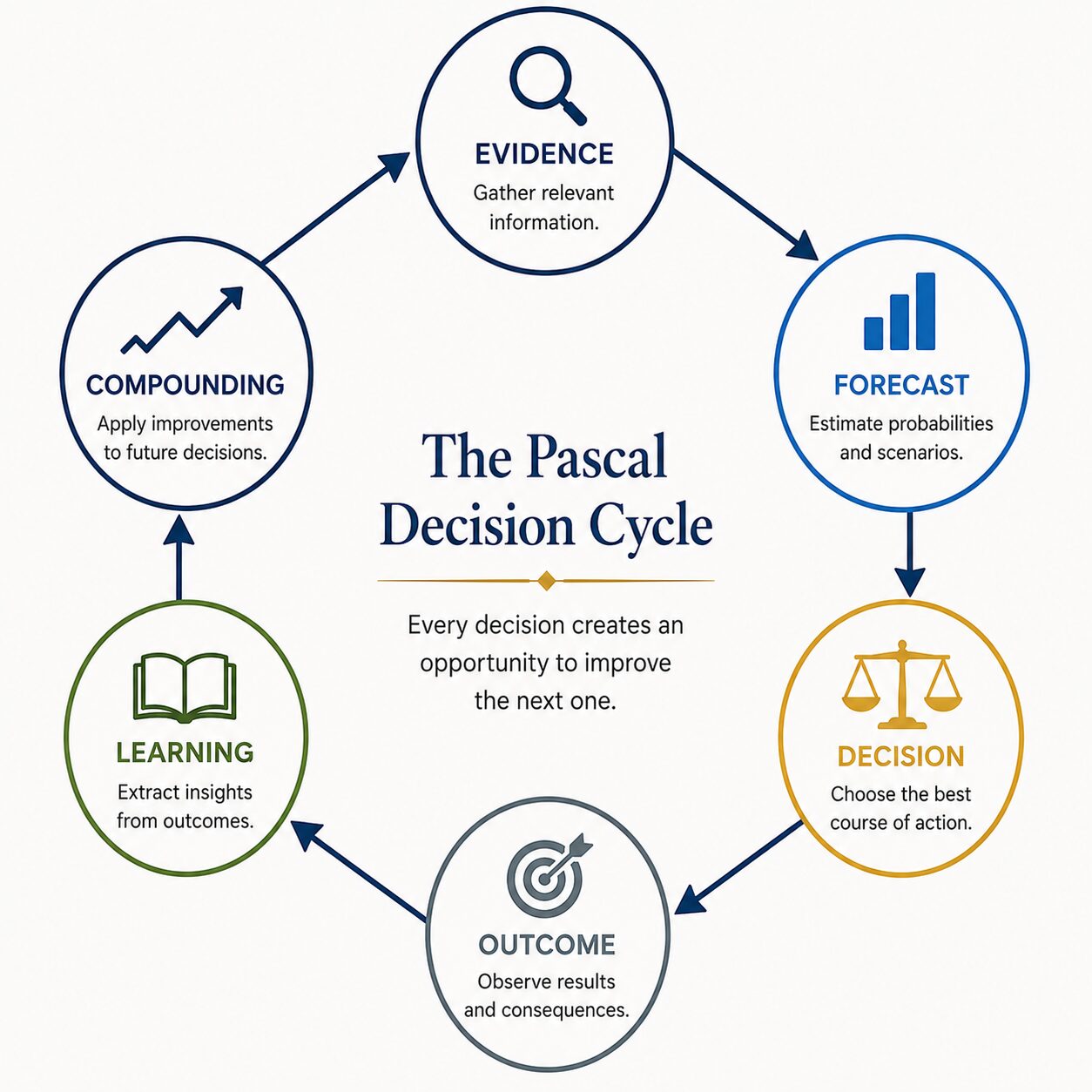
Evidence → Forecast → Decision → Outcome → Learning → Compounding → Evidence
The Pascal Decision Cycle puts these principles into motion. Evidence informs forecasts. Forecasts inform decisions. Decisions produce outcomes. Outcomes create opportunities to learn. Learning improves the evidence, forecasts, and decisions that follow.
But the process is not entirely passive between Decision and Outcome. As new evidence becomes available, a decision may need to be maintained, modified, or abandoned.
Every decision creates an opportunity to improve the next one.
Explore the Pascal Decision Cycle →
The Compounding Principle
A single improved decision may have little visible effect.
The power comes from repetition.
A slightly better forecast can produce a slightly better decision. Better sizing can preserve resources when a decision fails. Better review can expose a weakness in the process. That lesson can improve the next forecast.
Repeated hundreds or thousands of times, small improvements can accumulate into meaningful differences.
The inverse is also true.
Poor decisions compound too.
Repeated overconfidence, poor sizing, ignored evidence, failure to quit, and outcome-based learning can systematically consume resources and opportunities.
Decision Science therefore should not be measured solely by whether the next decision succeeds.
Its value lies in creating a process capable of becoming better over time.
Improve the Decision.
We cannot eliminate uncertainty.
We can improve the evidence.
We can improve the forecast.
We can improve the decision.
We can improve how much we commit.
We can change course when the evidence changes.
We can learn from what happens.
And then we can do it again.
Start With the Decision Science Starter Guide
Download Publication 001