
Better decisions begin before outcomes are known.
Decision Intelligence is the practice of improving decisions under uncertainty. You do not need certainty to make a good decision. You need a disciplined process for using evidence, estimating what may happen, choosing an action, and learning from the result.
The Pascal Decision Cycle
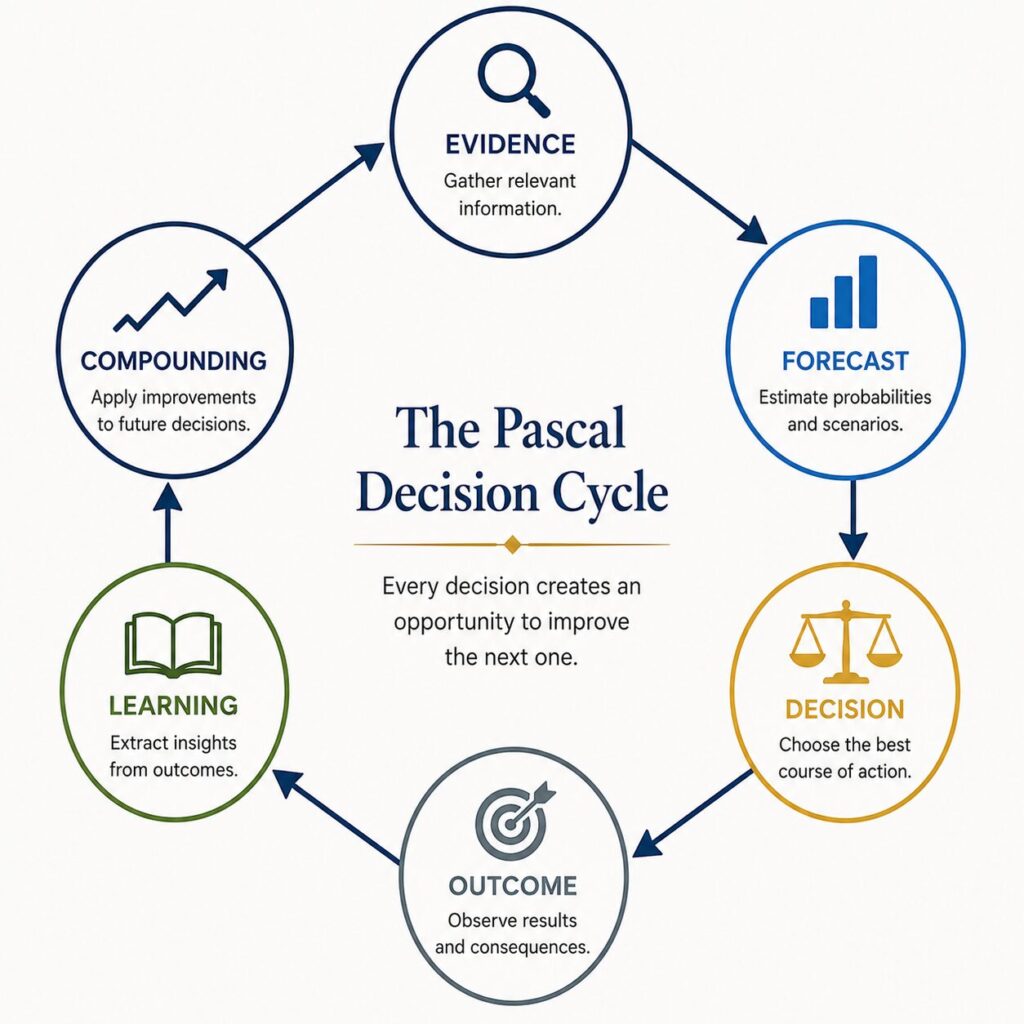
Every decision creates an opportunity to improve the next one.
The Pascal Decision Cycle provides a practical framework for continuous improvement. Gather the best evidence available. Translate that evidence into forecasts about what may happen. Choose a course of action. Observe the outcome without confusing it with the quality of the original decision. Learn from the difference between what you expected and what occurred. Apply those lessons to the next decision.
Evidence → Forecast → Decision → Outcome → Learning → Compounding → Evidence
Evidence
What do you know? What don’t you know? What information is relevant, reliable, and available before the decision must be made?
Forecast
What are the possible outcomes? Rather than predicting one outcome with certainty, estimate how likely the important possibilities are.
Decision
Given those probabilities, potential rewards, risks, alternatives, and constraints, what action offers the best tradeoff?
Outcome
Record what actually happened. Resist the temptation to immediately classify the original decision as good or bad based solely on the result.
Learning
Compare what you expected with what occurred. Was the evidence incomplete? Was the forecast poorly calibrated? Was the decision sound but unlucky? What should change?
Compounding
Carry what you learned into the next decision. Small improvements repeated across many decisions can become consequential.
Try It With Your Next Decision
Before making your next meaningful decision, write down:
- What evidence am I using?
- What outcomes are possible?
- What probability would I assign to each?
- What am I deciding, and why?
- How much am I willing to commit or risk?
- What information would cause me to change or abandon the decision?
- Afterward, what happened and what did I learn?
Don’t wait until you know the outcome to explain why you made the decision. Record the reasoning before the outcome is known.
Go Deeper
The Decision Intelligence Starter Guide introduces the process. Publication 001 explores the principles behind it, including probability, decision quality, outcomes, learning, and compounding.