
Learn to make better decisions under uncertainty.
Pascal Institute is the educational and research arm of the Pascal Initiative, dedicated to advancing the practical study of Decision Intelligence.
We explore how evidence, probability, forecasting, analytics, behavioral science, and disciplined resource allocation can improve decisions when outcomes cannot be known in advance.
Our purpose is not to tell people what to think.
It is to teach better ways to decide.
Why Pascal Institute Exists
We have more information than at any point in history.
Organizations collect enormous amounts of data. Models make increasingly sophisticated predictions. Markets aggregate information in real time. Artificial intelligence can analyze evidence and generate forecasts at extraordinary speed.
Yet better information does not automatically produce better decisions.
Someone still has to decide which evidence matters, how much confidence to place in a forecast, what risks are acceptable, which opportunity offers the greatest value, how much to commit, when new evidence justifies changing course, and what should be learned afterward.
Pascal Institute exists to study and teach that process.
We call that process Decision Intelligence.
Explore Decision Intelligence →
Our Approach
Pascal Institute begins with a simple premise:
The outcome of a decision and the quality of a decision are not the same thing.
Uncertainty guarantees that good decisions will sometimes produce bad outcomes and poor decisions will sometimes succeed.
If we learn only from whether we won or lost, we risk rewarding bad processes and abandoning good ones.
Instead, we examine what was knowable when the decision was made. What evidence was available? What did we expect to happen? How confident were we? What alternatives existed? What was at risk? How much did we commit? What would have caused us to change course?
Then we examine the outcome, not simply to determine whether we were right, but to identify what the experience can teach us.
This is the foundation of the Pascal Framework.
Explore the Pascal Framework →
The Principles We Teach
Evidence Over Opinion
Begin with the best evidence reasonably available. Distinguish facts from assumptions and confidence from certainty.
Think in Probabilities
The future rarely offers certainty. Estimate what could happen and how likely the meaningful outcomes are.
Decide on Value
The most likely outcome is not necessarily the best opportunity. Consider probability alongside potential reward, downside, cost, and alternatives.
Allocate With Discipline
A good opportunity does not justify unlimited commitment. Capital, time, attention, and other resources should be allocated according to edge, uncertainty, and risk.
Be Willing to Update
New evidence should change decisions when it changes the underlying probabilities. Persistence is valuable only while continuing remains justified.
Learn From Outcomes
Record expectations before outcomes are known. Evaluate the process separately from the result and carry what you learn into the next decision.
Then:
Small improvements repeated over time can compound. So can small mistakes.
Learn Through Real Decisions
Decision Intelligence becomes easier to understand when the consequences are real.
That is why Pascal Institute studies decision-making through domains where uncertainty, probability, risk, incentives, and outcomes are visible.
Sports & Wagering
Sports provide an unusually clear laboratory for Decision Intelligence. Probabilities can be estimated, market expectations are observable, decisions repeat frequently, outcomes arrive quickly, and performance can be measured.
A wager can lose while still having positive expected value. A winning wager can have been a poor decision. That makes sports an effective environment for learning to separate process from outcome.
Investing
Investing introduces longer time horizons, portfolio effects, capital allocation, asymmetric outcomes, changing information, and the behavioral difficulty of acting under uncertainty.
The objective is not to predict every market movement. It is to make decisions where expected return justifies risk and allocate capital accordingly.
Business
Organizations continually decide where to allocate scarce resources before knowing the result. Hiring, product development, strategy, pricing, expansion, and investment all require forecasts about uncertain futures.
Decision Intelligence moves analysis beyond what happened? toward the more consequential question:
What should we do next?
Everyday Decisions
The same principles apply whenever we commit scarce resources under uncertainty.
Careers, projects, purchases, education, and other consequential choices all involve evidence, probabilities, alternatives, opportunity costs, and changing information.
The domain changes.
The decision principles remain remarkably similar.
The Pascal Decision Cycle
Here I would show the cycle, but not explain every stage again.
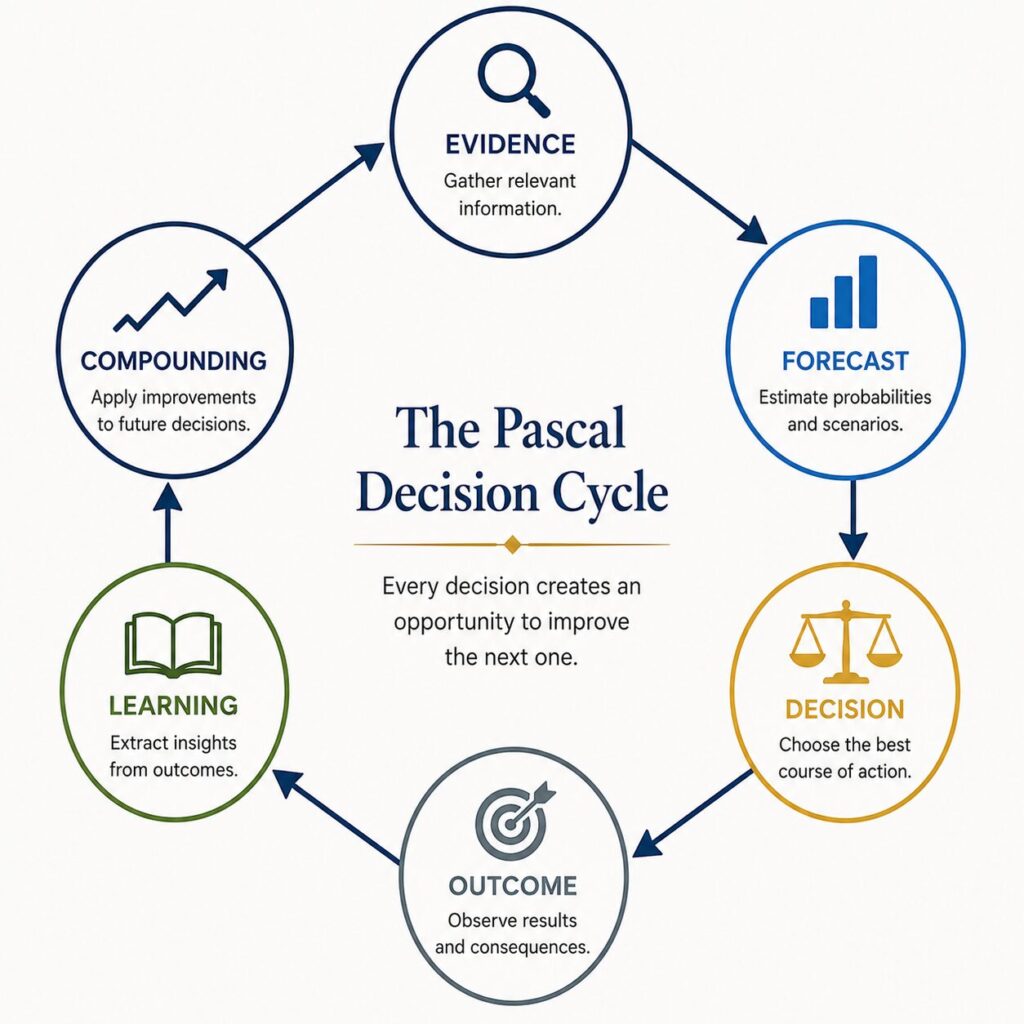
Evidence → Forecast → Decision → Outcome → Learning → Compounding
The Pascal Decision Cycle provides a structure for putting these principles into practice. Each decision produces information that can improve the next one, creating a continuous process of forecasting, deciding, measuring, and learning.
Explore the Pascal Decision Cycle →
Publications & Research
Pascal Institute publishes practical guides, research, case studies, tools, and analysis focused on improving decisions under uncertainty.
Topics include probability and forecasting, expected value, capital management, behavioral bias, decision evaluation, calibration, risk, opportunity cost, knowing when to quit, and learning from outcomes.
The objective is to connect theory with decisions people actually face.
Decision Intelligence: A Practical Guide to Better Decisions Under Uncertainty
An introduction to the principles behind Decision Intelligence and the Pascal approach to improving decision quality.
We Don’t Sell Certainty
Pascal Institute does not promise perfect predictions, guaranteed outcomes, winning investments, successful wagers, or decisions without risk.
Those promises are incompatible with uncertainty.
We believe something more useful is possible.
We can improve how evidence is evaluated. We can make uncertainty explicit. We can become better calibrated. We can allocate resources more intelligently. We can recognize when circumstances have changed. We can evaluate decisions without being deceived by outcomes. And we can systematically apply what we learn to the decisions that follow.
The goal is not certainty.
The goal is a better decision process.