
On August 10, the New York Mets were playing the Atlanta Braves at Truist Park when an unusual sequence unfolded in the top of the first inning.
At the time, there was little reason to believe the play would become significant. The game had barely started, the Mets had only one runner on base, and the Braves had both of their ABS challenges available.
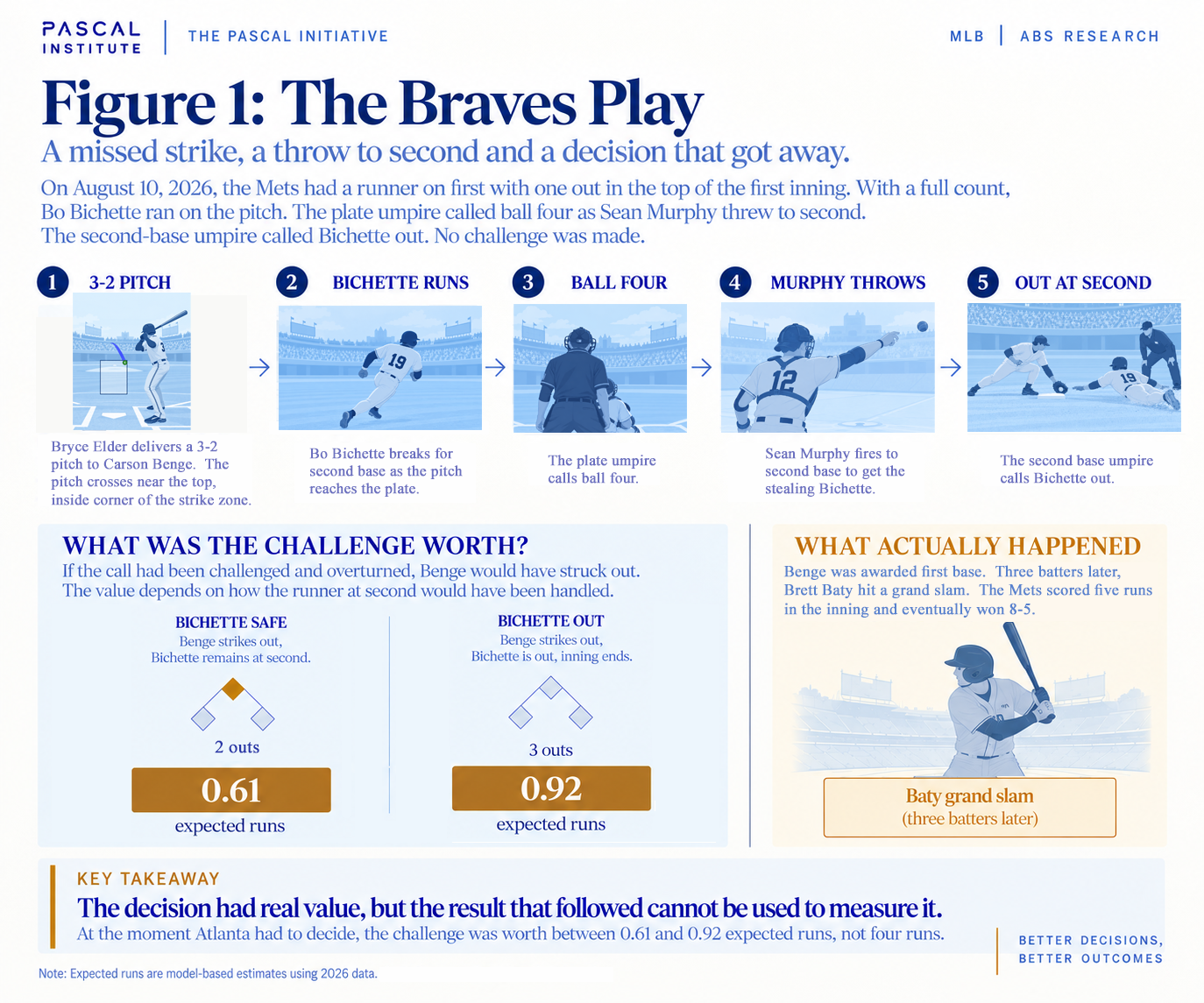
Bo Bichette stood on first base with one out while Carson Benge faced Braves starting pitcher Bryce Elder. The count eventually reached three balls and two strikes. With the count full, Bichette took off for second as Elder delivered the pitch. Braves catcher Sean Murphy received the ball near the top of the strike zone and immediately came out of his crouch. His attention turned to Bichette, who was racing toward second. Murphy transferred the ball from his mitt and fired a throw to second base. The throw beat Bichette, and the second-base umpire called him out. At nearly the same time, the home plate umpire called Elder’s pitch ball four.
The pitch was actually a strike.
The pitch was up and in to the left-handed Benge, and by the ABS zone it was likely a strike with room to spare. It would have had to be about 2.7 inches farther out to miss the zone entirely, nearly the diameter of a baseball. Had Atlanta successfully challenged the call, Benge would have struck out. Instead, ball four stood, Benge was awarded first base, and Bichette was entitled to second. No challenge was made.
Video of the play clearly shows Murphy made the throw and the second-base umpire called Bichette out, but the ball-four call ultimately made the play at second irrelevant.
Of course what the video does not show, nor does StatCAST tell us, is why Atlanta failed to challenge. Perhaps Murphy was too occupied with the play at second to immediately process the location of the pitch. Perhaps he was unsure whether the pitch had actually caught the zone. Perhaps the challenge window simply disappeared while the play was unfolding. The video can show us what happened, but it cannot tell us what Murphy was thinking.
What happened next makes the missed opportunity much easier to remember. The Mets eventually loaded the bases, and three batters after Benge’s walk, Brett Baty hit a grand slam. By the time the Braves finally escaped the inning, New York had scored five runs. The Mets eventually won the game 8-5.
Knowing what happened afterward makes it tempting to assign enormous importance to the missed challenge. If Atlanta challenges the pitch and wins, Benge strikes out. Depending on how the play at second would have been handled, the Braves might have recorded the second out or completed what amounted to an inning-ending strikeout and caught stealing. There would have been no Baty grand slam. It would be easy to conclude the missed challenge cost Atlanta four runs. It would also be wrong.
At the moment the Braves had to decide whether to challenge, Baty’s grand slam had not happened. Nobody knew the bases would eventually become loaded, and nobody knew what Baty would do when he came to the plate. Using those later events to evaluate the earlier decision gives Atlanta information it could not possibly have possessed. The better question is not how many runs scored afterward. The better question is how much the challenge was worth when Atlanta had the opportunity to make it.
Depending on how the runner at second would have been handled, correcting the call was worth somewhere between 0.61 and 0.92 expected runs to Atlanta. That is a significant amount for a single pitch in the first inning, but it is still a long way from four runs. The difference between those two numbers, the expected value when the decision was made and the result that followed, is where the fourth part of our ABS investigation begins.
Putting a Value on the Call
The first three articles in our ABS series focused primarily on recognition. We started by examining how often hitters challenged incorrect strikes and discovered that they did so less than one time in five. From there, we looked at the characteristics of the pitch and found that some incorrect calls are much easier to identify than others. In the third article, we found evidence that the hitter also matters. Some hitters challenged incorrect calls more often than expected, even after accounting for the opportunities they faced.
Those findings left another possibility to consider. A player might believe a call was wrong and still decide not to challenge. Under the ABS system, challenges are a limited resource. If a challenge is successful, the team keeps it. If the challenge fails, one of the team’s challenges is lost. A player who believes an umpire missed a pitch must therefore make two judgments. He has to decide whether the call was probably wrong, but he also has to decide whether he is confident enough to risk something his team may need later.
To investigate that question, we had to expand our research beyond hitters. Challenges belong to the team, not to the offense. A challenge saved by a hitter in the third inning may be used by a catcher to contest a ball in the seventh. We identified 10,755 incorrect strikes that created offensive challenge opportunities and another 9,409 incorrect balls that created defensive opportunities. In total, that gave us 20,164 incorrect calls to examine.
For each call, we reconstructed two versions of what happened. The first was the game state created by the umpire’s actual call. The second was the game state that would have existed if the call had been corrected. By comparing the two, we could estimate how many runs the correction was worth before knowing what happened on any later pitch.
One of the first things that became apparent was that incorrect calls do not have equal value. Consider two pitches that miss by exactly the same amount. The first comes with nobody on base and a 1-0 count. Correcting the call changes the count, but the plate appearance continues. The second comes on a 3-2 count. Depending on the runners and outs, correcting that call can turn a walk into a strikeout and dramatically change the inning. The umpire may have made essentially the same physical mistake on both pitches, but the consequences are very different.
Across the 20,164 incorrect calls in our study, correcting a call was worth an average of about 0.15 expected runs. Half of the opportunities were worth less than approximately 0.11 runs and half were worth more. The most valuable 10 percent of opportunities accounted for about 30 percent of all the available run value, while the top 20 percent accounted for 44 percent.
Counts near the end of a plate appearance were particularly important. Two-strike and three-ball counts represented only 19 percent of the incorrect calls in our study, but they accounted for 37 percent of the available value. Full counts were even more striking. Only about 3 percent of the opportunities occurred with a 3-2 count, yet those pitches represented roughly 11 percent of all correctable run value.
The reason is familiar to anyone who has watched much baseball. A missed call early in the count usually changes the count. A missed call late in the count can change who is still batting, who reaches base, how many outs there are, and whether the inning continues. The location of the pitch tells us how wrong the call was. The situation tells us how much the mistake mattered.

The Cost of Being Wrong
When we added the value of all 20,164 incorrect calls together, they represented approximately 3,098 runs of correctable value. Successful challenges recovered about 980 runs. Another 2,118 runs of correctable value were attached to incorrect calls that were never challenged.
At first glance, that number seems enormous. It would be tempting to conclude that teams left more than 2,000 runs on the field because players failed to challenge enough pitches. That is not what the number means. We have an advantage the player did not have. We already know which calls were wrong. We can examine the pitch after the fact, compare it with the ABS zone, and determine whether a challenge would have succeeded. The player has to make that judgment in a matter of seconds.
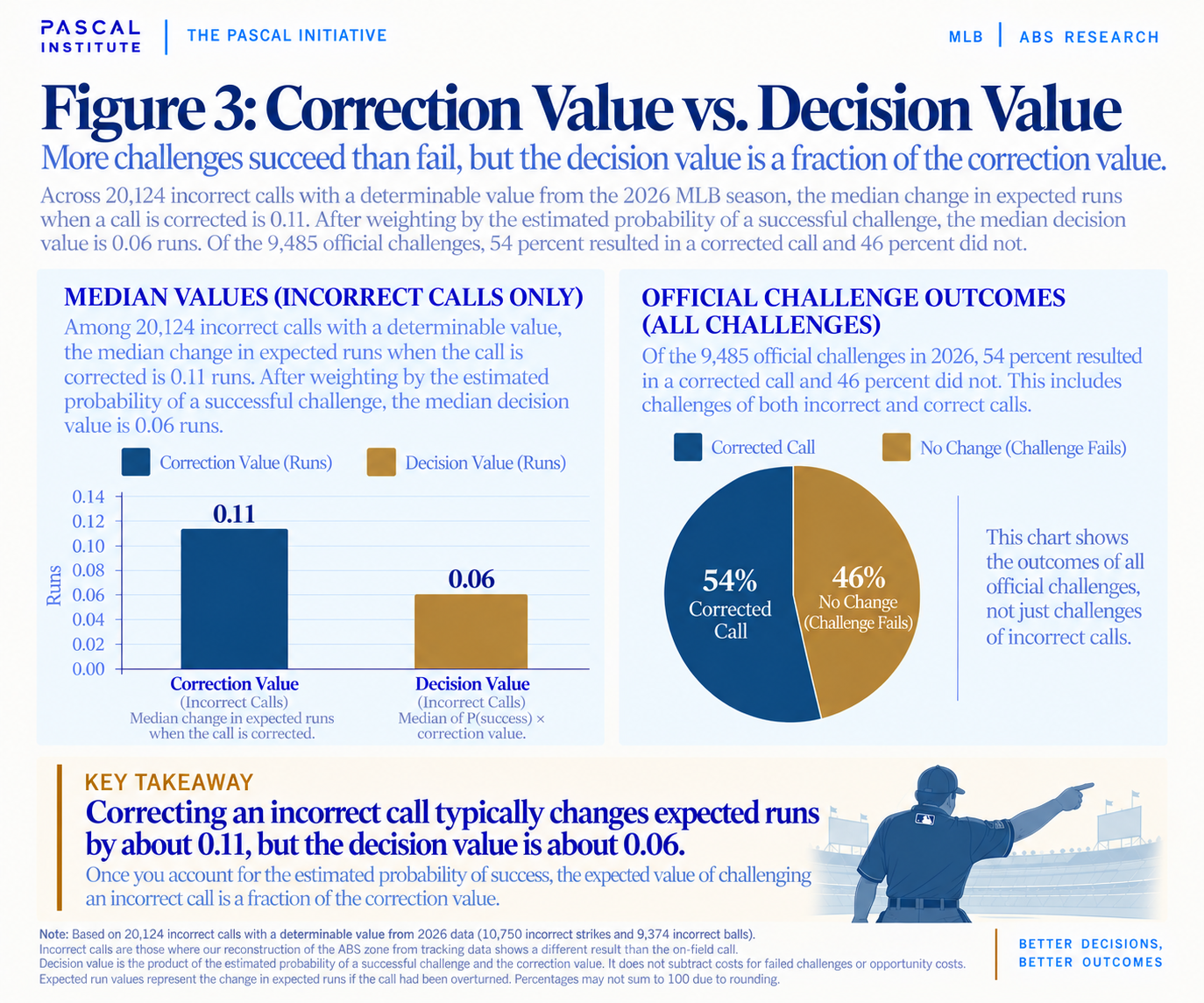
The difficulty of that judgment becomes apparent when looking at all official challenges rather than only the successful ones. About 46 percent of the 9,485 challenges in our study failed. Players were wrong almost as often as they were right. A player is therefore not deciding whether to correct a call known to be wrong. He is deciding whether the chance that the call is wrong is high enough to justify risking a limited resource.
This distinction led us to separate two ideas. The first is correction value, which tells us how much changing a call is worth if we already know the umpire was wrong. The second is decision value, which considers the uncertainty the player faces when he must actually make the choice. Once that uncertainty was included, the median immediate value of challenging fell from about 0.11 runs of correction value to approximately 0.06 expected runs. The average fell from about 0.15 to about 0.08 runs.
This does not mean the lower number is the true value of every challenge. A hitter or catcher may have information our data cannot see. That player knows where they expected the pitch to finish, how it looked leaving the pitcher’s hand, and what their own eyes told them as it crossed the plate. Our model cannot reproduce that experience. The estimate simply gives us a way to account for an important fact that is easy to overlook when studying challenges after the game: the player does not know the answer when making the decision.
Saving the Challenge
There is another side to the decision. Even if the current opportunity has value, an unsuccessful challenge can remove the team’s ability to correct a more important call later. Saving the challenge therefore has value of its own.
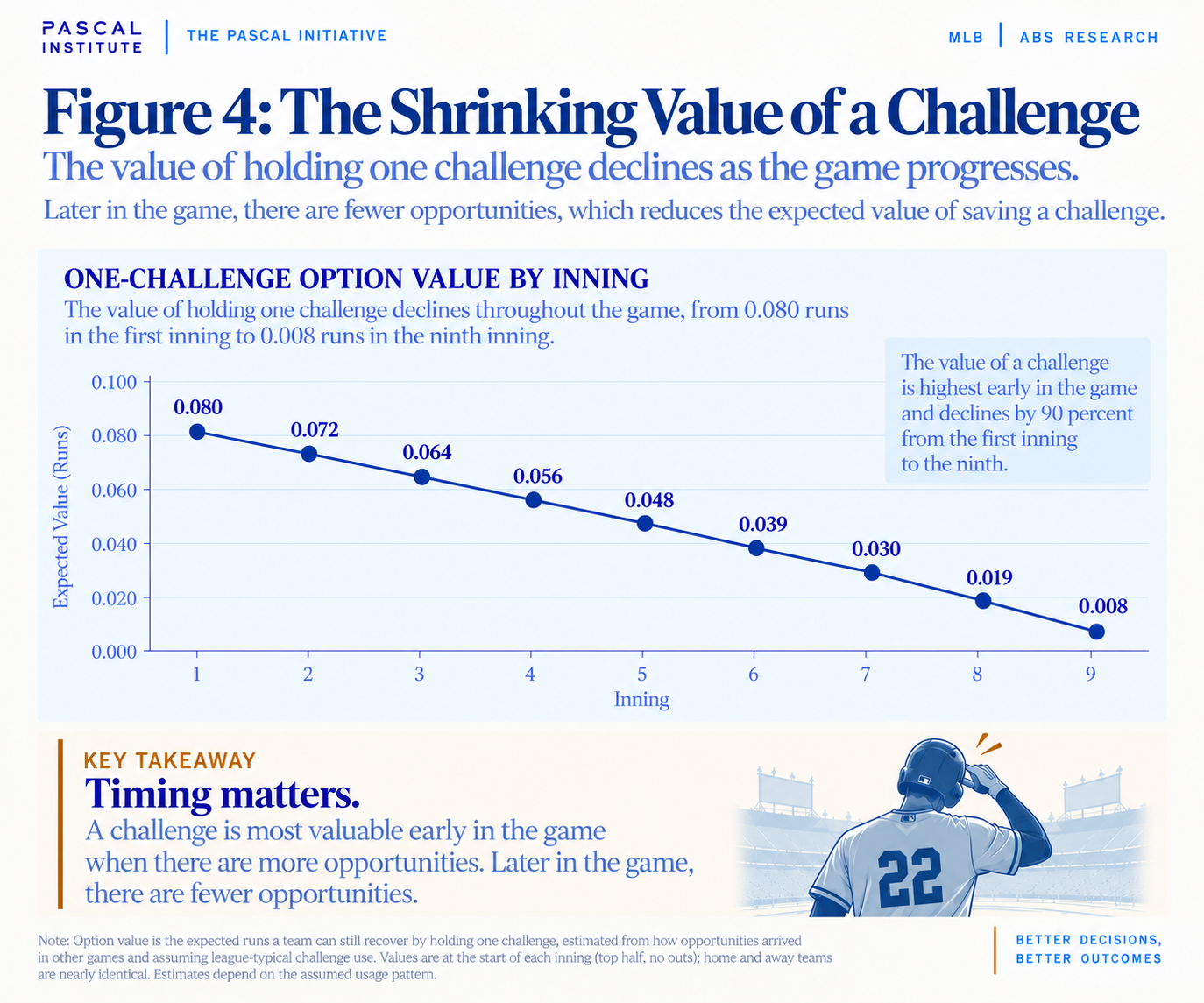
That value changes as the game progresses. At the beginning of the first inning, there are dozens of plate appearances and hundreds of pitches still to come. There is plenty of time for another questionable call to occur. By the seventh or eighth inning, many of those future opportunities have disappeared. By the ninth, there may never be another chance to use the resource.
Using the way teams typically challenged during the season, we estimated that having one challenge available at the beginning of the game was worth about 0.08 expected runs. By the third inning, the value had fallen to approximately 0.06. In the fifth it was about 0.05, and by the seventh it had dropped to approximately 0.03. At the beginning of the ninth inning, preserving that challenge was worth less than 0.01 expected runs.
The exact values depend on assumptions about how future opportunities arrive and how teams use their challenges, so the numbers should not be treated as fixed values for every game. The pattern is more important. A challenge is a resource with an expiration date. There may be good reason to save one early because there is a great deal of baseball left to play. The same logic becomes weaker with each passing inning because the number of future opportunities continues to shrink.
With that in mind, we returned to the question that originally led us down this path. We wanted to know whether players become more reluctant to challenge when their team has only one remaining. The answer appears to be yes, although the reason is more complicated than we expected.
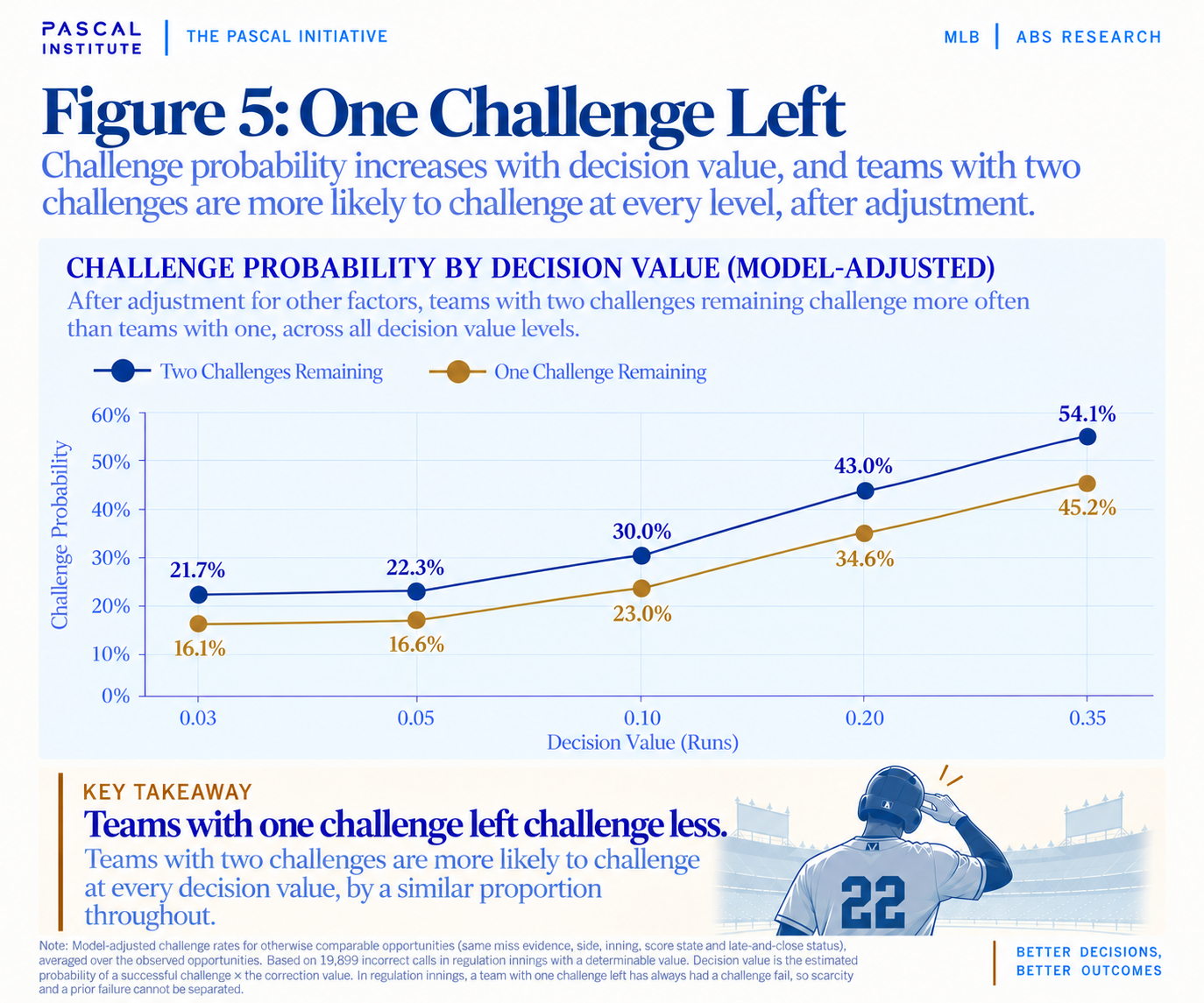
In our initial analysis, having one challenge remaining was associated with substantially less challenging than having two. We then accounted for the value of the current opportunity, the inning, the future value of preserving the challenge, and other characteristics surrounding the decision. The difference became smaller, but it remained. Depending on how we measured the decision, the odds of challenging were roughly 20 to 27 percent lower for teams with only one challenge remaining than for comparable teams with two available.
There is an important problem with interpreting that result. During the first nine innings, a team with only one challenge remaining has already made an unsuccessful challenge. Two things have therefore changed at the same time. The team has fewer challenges, but it has also already been wrong once. We cannot completely separate those effects with the data available. Perhaps the team is protecting its final challenge, perhaps the previous failure affects subsequent decisions, or perhaps teams have rules about how the final challenge should be used. Teams also challenged more often after a successful challenge, so part of the gap between one and two challenges reflects more aggressive challenging after success, not only caution after failure. What we can observe is that challenge behavior changes once the team reaches that state.
Waiting for Something Better
If teams are deliberately protecting their last challenge, a logical strategy would be to become more selective. With two challenges remaining, a player might be willing to contest a moderately valuable call. With one remaining, he might let that call go but still challenge a much more important one. If that is what is happening, the threshold for using the resource should rise as challenges become scarce.
We did not find that pattern. More valuable calls were more likely to be challenged, which is exactly what we would expect. However, after accounting for inning and other factors, having only one challenge remaining reduced challenge activity across the range of values. We did not find evidence that teams simply stopped challenging less important calls while continuing to challenge the most valuable ones at the same rate. Instead, the overall willingness to challenge appeared to move lower.
That distinction does not tell us teams are making poor decisions. We still cannot observe exactly how confident a player was, and there may be team instructions or other information that does not appear in the data. It does, however, raise a natural question. If teams become more reluctant to use the resource because they may need it later, how often does a better opportunity actually arrive?
To explore that question, we identified 126 unchallenged opportunities during the first three innings that were worth at least half a run if corrected. These were some of the more valuable early opportunities in the study. We then followed the remainder of each game to see whether a more valuable opportunity appeared later. It happened only 8.7 percent of the time.
This is a hindsight result, and it has to be treated that way. A team in the second inning cannot know what challenge opportunities will appear in the seventh. The finding does not mean those teams should have known to challenge the earlier pitch. It shows the other risk involved in conservation. Saving a challenge guarantees that the resource remains available, but it cannot guarantee there will be a better reason to use it.
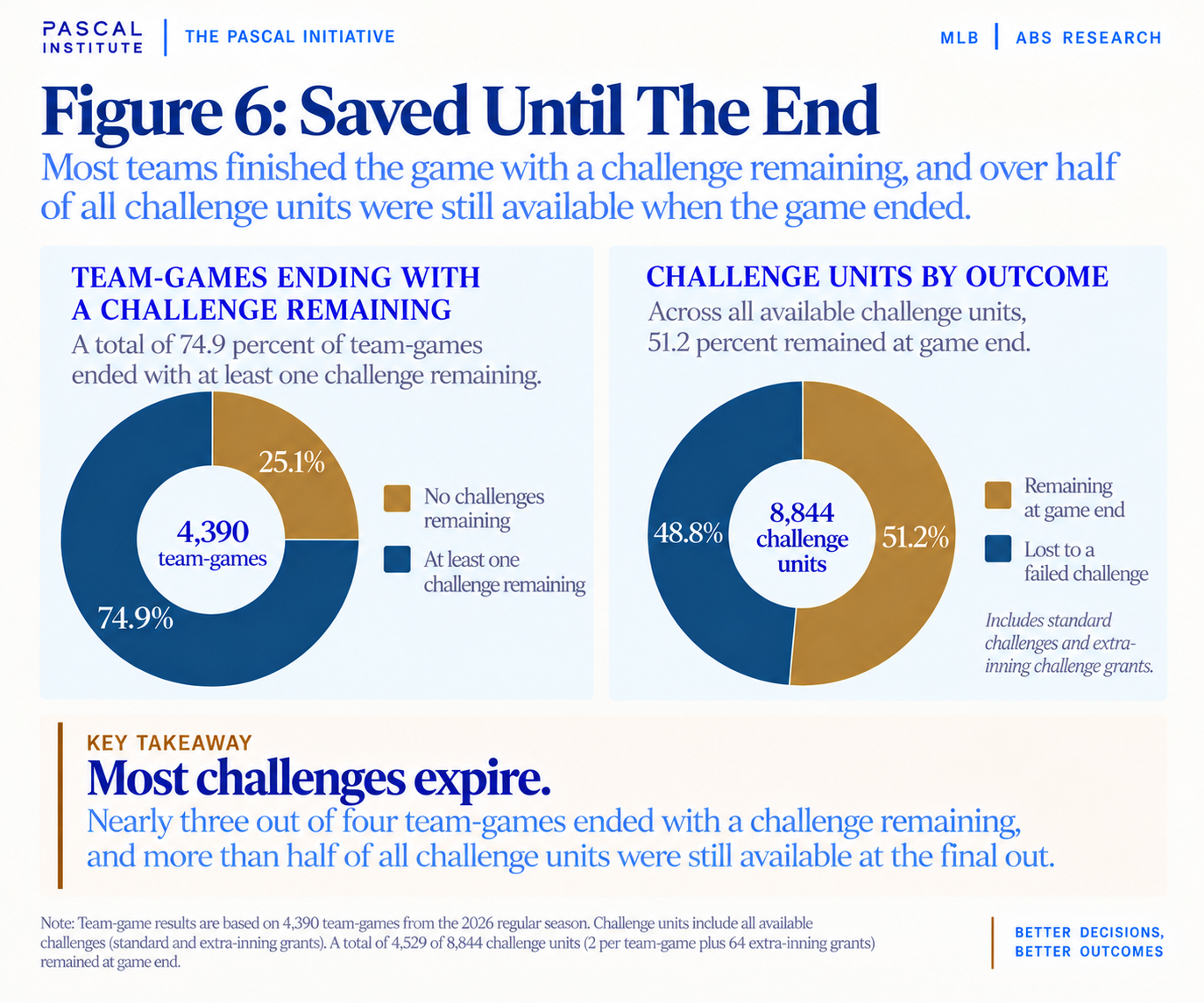
The broader data told a similar story. Nearly 75 percent of team-games ended with at least one challenge still available. When we counted individual challenge units, including additional challenges granted in extra innings, just over half were still available at the final out. A challenge remaining at the end does not automatically represent a mistake because a team may simply never have encountered a call it was confident enough to contest. Still, the challenge remaining after the final out has no future value. Teams are balancing the risk of using a challenge and losing it against the risk of saving a challenge for an opportunity that never arrives.
Back to Atlanta
The first inning in Atlanta gives us a useful way to bring those pieces together. We know Elder’s pitch crossed inside the ABS strike zone. Depending on what happened with Bichette at second, correcting the call was worth between 0.61 and 0.92 expected runs to the Braves. Atlanta did not know with certainty that the challenge would succeed, and our estimate based on observable information put that probability at about 53 percent. Once that uncertainty is included, the immediate expected value of challenging was approximately 0.32 to 0.49 runs.
Atlanta also had both challenges available. Under our primary estimate, the future value risked by losing one was only about 0.01 runs. The opportunity in front of Atlanta was therefore valuable, while the cost of risking one of its two challenges was relatively small. We cannot know why no challenge was made, and the unusual action at second may have played a role. What we can say is that the decision window closed quickly, and the opportunity disappeared with it.
Three batters later, Baty hit the grand slam. The home run is the reason the play caught our attention, but it should have no role in determining what the challenge was worth. Had Baty grounded into a double play instead, nothing about the earlier opportunity would have changed. Atlanta still faced the same pitch, the same count, the same runners, and the same uncertainty when the decision had to be made. The result changed dramatically, but the quality and value of the earlier decision did not.
That is the difficult balance created by the ABS challenge system. A team must decide whether the opportunity in front of it is worth risking a resource that might be more useful later, knowing there may never be a better opportunity at all. Atlanta’s first-inning opportunity was not worth four runs because a grand slam happened three batters later, but it was worth considerably more than the average challenge opportunity in our study. The Braves let a valuable opportunity pass, although the available evidence cannot tell us whether the pitch went unrecognized, the play at second interfered with the decision, or Atlanta simply chose not to challenge.
The larger lesson is not that teams should challenge every close call or stop saving challenges for later innings. A challenge has value because it can correct a mistake now, but it also has value because it can be preserved for a mistake that has not happened yet. The difficulty is that the opportunity in front of a player is real, while the better opportunity he is waiting for may never arrive.
How Expected Run Value Is Determined
Expected run value estimates how many runs a team is likely to score from a particular count, number of outs, and baserunner configuration through the end of the inning, based on hundreds of thousands of observed MLB pitches. For each incorrect call in this study, we compared the run expectancy of the state created by the umpire’s call with the state that would have existed if the call had been corrected. The difference is the correction value, and no runs that happened later in the inning are used to determine it.
Read the Article 4 methodology, definitions, assumptions and interpretive limits.