
In the top of the sixth inning of Game 5 of the 2026 World Series, Milwaukee held a 3-0 lead over Tampa Bay. There was one out, with William Contreras on third base and Brice Turang on second. Cooper Pratt was ahead 1-0 in the count against Tyler Wells when he lifted a high fly ball toward the right-field corner.
Tampa Bay right fielder Ryan Vilade moved toward the line and made the catch in foul territory, approximately 249 feet from home plate and 34 feet beyond the foul line. Contreras tagged from third and scored. Turang advanced to third, and Milwaukee extended its lead to 4-0.1
At first glance, there was nothing particularly unusual about the play. Vilade caught a ball he could reach, recording the second out of the inning. It was the kind of defensive play that players are taught to make from the time they begin playing baseball. When a ball is hit in the air and you can catch it, you catch it.
But what if catching the ball was not the best decision?
Vilade had another option. He could have allowed the ball to land in foul territory. Contreras would have remained at third, Turang at second, and Pratt would have continued his at-bat with a 1-1 count. Tampa Bay would have surrendered an opportunity to record an out, but it also would have prevented Contreras from scoring on the play.
The decision presents an interesting trade-off. Is it better to accept a likely run in exchange for an out, or preserve the current score and give the offense another opportunity to hit?
We know how the play ended, but that does not necessarily tell us whether Vilade made the correct decision. To answer that question, we need to consider what Tampa Bay could reasonably have expected from each alternative before the ball reached his glove.
The Value of an Out
Outs are among the most valuable resources in baseball. In a regulation nine-inning game, each team has 27 outs available to produce as many runs as possible. Once those outs are exhausted, the team's opportunity to score is over, unless the game continues into extra innings.
From the defensive perspective, recording an out reduces the opportunities available to the opposing team. With three outs required to end an inning, moving from one out to two is an important step toward preventing additional runs.
However, the value of an out changes depending on the circumstances.
Consider Vilade's situation. Catching the ball would give Milwaukee two outs, but Contreras would have an opportunity to score. Allowing it to drop would leave Milwaukee with one out and runners on second and third. The first option reduces Milwaukee's remaining opportunities to score, while the second preserves another opportunity for what could become a larger inning.
Historical data provide some perspective on how frequently catching a fly ball results in a run. From 2023 through 2026, outfielders caught 6,114 fly balls with a runner on third and fewer than two outs in the regular-season data examined. The runner scored approximately 80% of the time, remained at third 18% of the time, and was thrown out at home 2% of the time.2
Those figures do not mean every runner has an 80% probability of scoring on a caught fly ball. Third-base coaches consider the depth of the fly, the runner's speed, the outfielder's arm, and several other factors before deciding whether to send the runner. A shallow fly caught by an outfielder charging toward home plate presents a different opportunity than a deep fly caught near the warning track.
Nevertheless, the historical results demonstrate that catching a fly ball with a runner on third frequently involves trading an out for a run. Whether that trade benefits the defense depends on what happens next.
Finding the Break-Even Point
To evaluate the Game 5 decision, we developed a model to estimate Tampa Bay's probability of winning under each alternative. The analysis uses league performance data from the 2023 through 2026 regular seasons, along with 2026 statistics for Pratt, Wells, and the hitters who would follow Pratt in Milwaukee's lineup.3
Individual player statistics can be misleading when based on relatively small samples. To reduce that influence, the model adjusts player estimates toward league averages. It then evaluates how the remainder of the inning and game might unfold if Vilade catches the ball or allows it to drop.
The most important variable is the probability that Contreras would score if Vilade made the catch.
If Contreras were almost certain to score, Tampa Bay would be surrendering a run in exchange for the out. If the fly were shallow enough that Contreras would likely remain at third, the catch would be considerably more valuable. Somewhere between those two possibilities is a point at which the expected benefit of catching the ball equals the expected benefit of allowing it to drop.
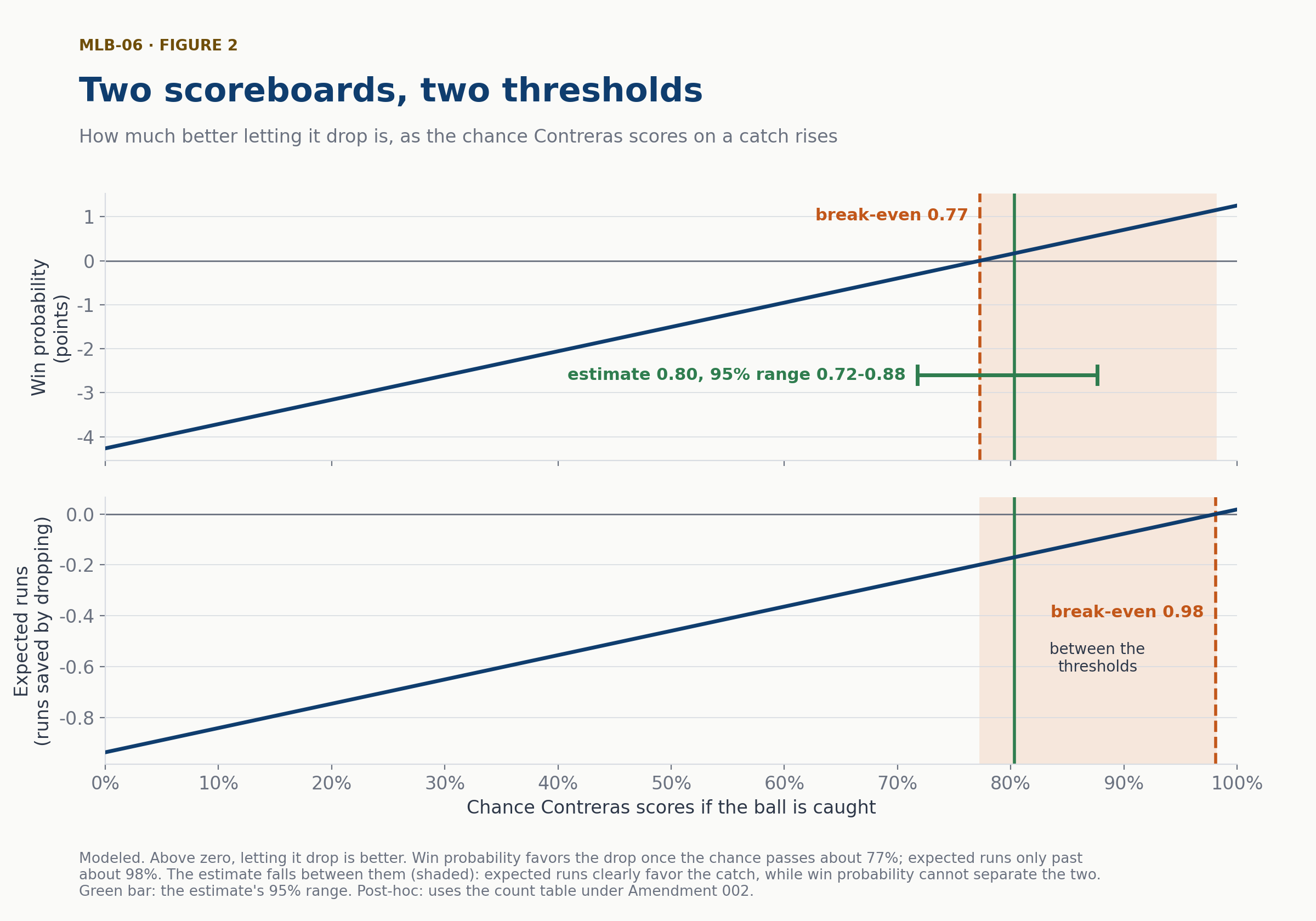
Under our primary model, that break-even point occurred when Contreras had approximately a 77% probability of scoring. Below that threshold, catching the ball was preferable. Above it, allowing the ball to drop produced a higher estimated probability of winning.
The threshold is specific to the Game 5 situation. It is not a general rule for catching foul balls, and it is not known with certainty. Our uncertainty range for that threshold runs from approximately 70% to 84%.
We also developed a separate model to estimate Contreras's probability of scoring. This model considers the distance and angle of the fly ball, the number of outs, and the runner's sprint speed. Based on those characteristics, it estimated that Contreras had approximately an 80% probability of scoring, with a plausible range of 72% to 88%.
The estimate falls slightly above the primary break-even threshold, suggesting that allowing the ball to drop may have been preferable. However, the uncertainty surrounding both estimates is substantial. The ranges overlap enough that we cannot confidently conclude one decision was better than the other.
Was It Worth Catching?
When we translated the two alternatives into win probability, the difference was remarkably small.
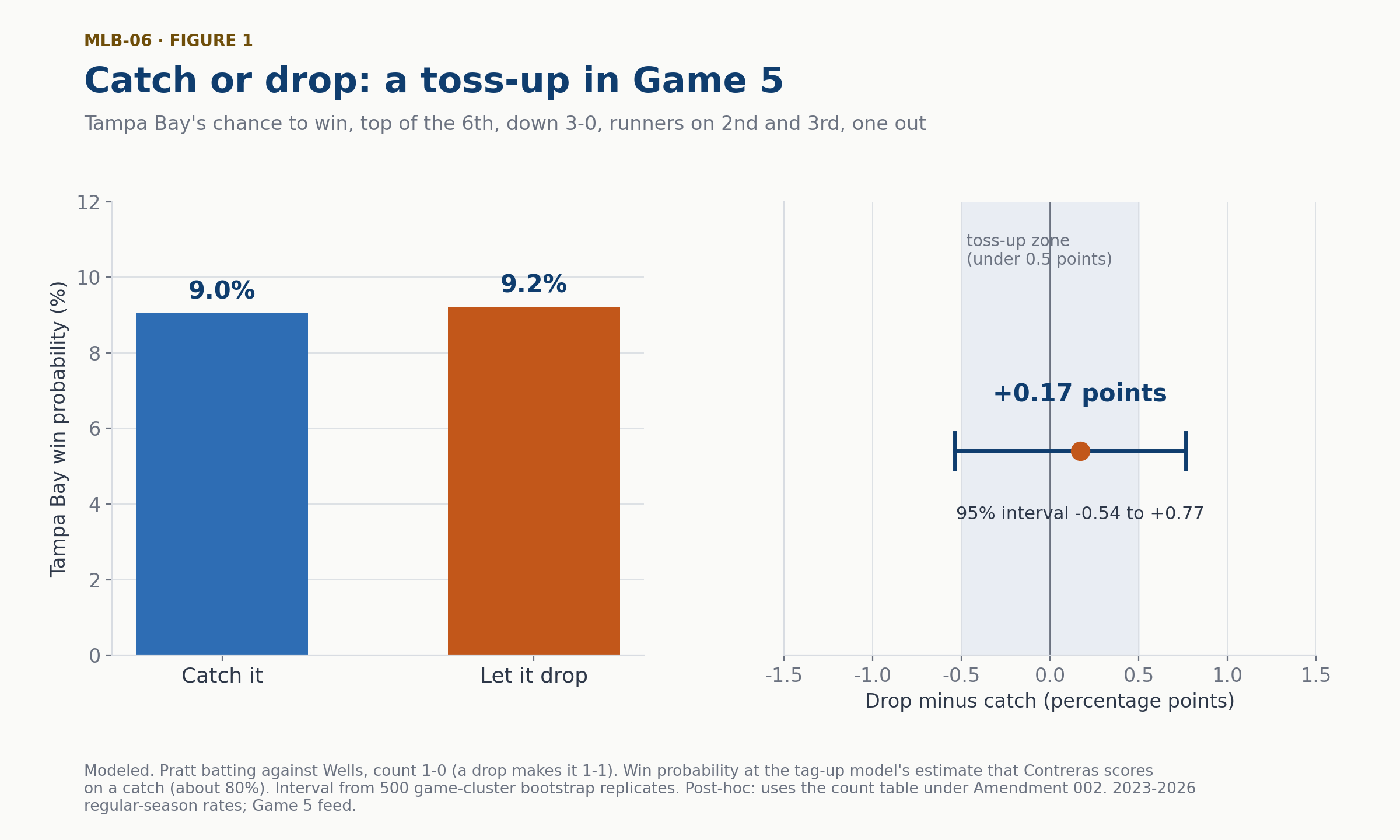
Tampa Bay's estimated probability of winning was approximately 9.0% following the catch, compared with 9.2% if Vilade had allowed the ball to drop. The difference was just 0.17 percentage points in favor of dropping the ball.3
The 95% uncertainty interval for that difference extended from -0.54 to +0.77 percentage points. In other words, the analysis was consistent with either choice being slightly better.
Before computing any results, we established categories for interpreting them. Differences of less than half a percentage point would be classified as a toss-up, while advantages of at least one percentage point would be considered clear under our decision framework.
By that standard, Game 5 was a toss-up.
Although the model slightly favored allowing the ball to drop, the advantage was too small to justify a confident recommendation. Vilade may have made the better decision by catching the ball, or he may have surrendered a small opportunity to improve Tampa Bay's chances. The available evidence does not allow us to distinguish between those possibilities with sufficient confidence.
That conclusion may seem unsatisfying, particularly when the original question asks whether Vilade should have caught the ball. But the purpose of the analysis is not to produce a definitive answer simply because we would like one. It is to determine what the evidence supports and how much confidence we should place in the result.
What Happens When One Run Changes Everything?
The decision becomes considerably more interesting when we change the inning and score.
Imagine the same situation in the bottom of the ninth inning of a tied game. The home team has a runner on third with fewer than two outs, and the batter lifts a catchable fly into foul territory.
If the outfielder catches the ball and the runner scores, the game is over. The defense has successfully recorded an out, but that out has no remaining value because the winning run has crossed the plate.
Allowing the ball to drop, on the other hand, preserves the tie and gives the defense another opportunity to retire the batter. The offense still has a runner on third and fewer than two outs, so the threat remains. But the defense has avoided surrendering the winning run on that particular play.
Our analysis suggests that catching the ball in this situation is preferable only when the runner's probability of scoring is below approximately 40% to 65%, depending on the ball-strike count, the number of outs, and the assumptions used in the model.
A shallow fly ball may still be worth catching, particularly if the outfielder has a reasonable opportunity to hold the runner at third. A deep fly that would almost certainly allow the runner to score presents a different decision.
This illustrates why the value of an out cannot be considered independently of the game situation. Recording an out is normally beneficial, but in the bottom of the ninth inning of a tied game, the defense cannot afford to surrender even one run. Under those circumstances, preserving the score may be considerably more important than recording another out.
Expected Runs and the Probability of Winning
There is another way to evaluate Vilade's decision, and it produces an interesting distinction.
Baseball analysts frequently use expected runs to estimate how many runs a team is likely to score from a particular combination of runners and outs. These estimates help evaluate offensive opportunities, defensive decisions, and the potential consequences of different strategies.
For the Game 5 play, our model estimated that Milwaukee would score approximately 1.15 runs if Vilade caught the ball, compared with 1.32 runs if he allowed it to drop. Both figures include all runs beginning at the moment of the decision, including Contreras's run if the catch was made.
By that measure, catching the ball was preferable. Tampa Bay would surrender a likely run, but reducing Milwaukee's remaining opportunities to score would lower its expected offensive production. The result remained consistent across the uncertainty scenarios evaluated.
However, the analysis becomes more interesting when we compare expected runs with win probability.
Using expected runs, catching the ball was preferable unless Contreras's probability of scoring exceeded approximately 98%. Using win probability, the primary break-even threshold was only 77%.
Why would the two measures produce different recommendations?
The distinction comes from what each measure is designed to evaluate. Expected runs estimate how many runs an offense is likely to score, while win probability considers how those runs affect the eventual outcome of the game.
Tampa Bay was already trailing by three runs in the sixth inning. In our model, a catch made exactly one more Milwaukee run the most likely outcome, and Milwaukee was held scoreless in the rest of the inning only about 16% of the time. A drop raised that scoreless chance to about 35%, but it also raised the chance of two or more runs from about 22% to about 40%. The relationship between runs allowed and the probability of winning is not necessarily linear, particularly when the score and inning are taken into consideration.
A strategy that slightly increases the average number of runs allowed can still improve the probability of winning if it changes the distribution of possible outcomes in a favorable way.
In Game 5, expected runs favored catching the ball, while win probability could not reliably distinguish between the alternatives. The two measures were evaluating the same decision, but they were answering different questions.
If the objective is to minimize expected runs allowed, catching was the better choice under our model. If the objective is to maximize Tampa Bay's probability of winning, the result remains inconclusive.
For a team trying to win a baseball game, win probability is ultimately the more relevant measure.
When the Decision Is Not Close
Although the Game 5 decision was effectively a toss-up, our research identified situations in which the difference becomes much more substantial.
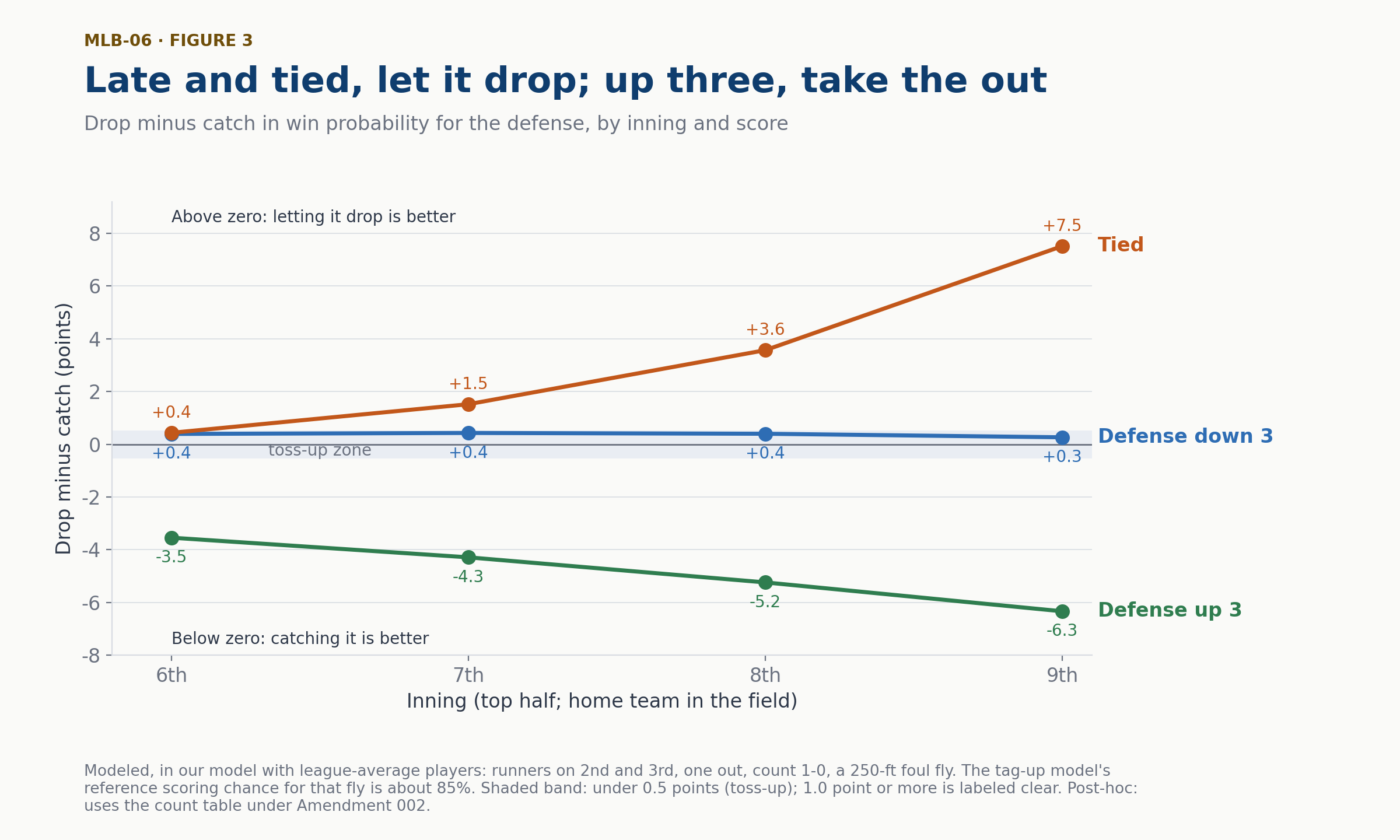
We modeled a series of scenarios using league-average players, a home team playing defense, runners on second and third, one out, a 1-0 count, and a catchable foul fly approximately 250 feet from home plate. We then changed the inning and score to examine how those factors affected the preferred decision.
In a tied game, allowing the ball to drop was favored in the seventh inning under our primary model. The advantage became more substantial in the eighth and ninth innings, reaching approximately 3.6 and 7.5 percentage points of win probability, respectively.
These are meaningful differences. An advantage of several percentage points represents a substantial improvement in the probability of winning, particularly when it results from a decision that might otherwise be made almost automatically.
The results changed when the defense held a three-run lead. Under those conditions, catching the ball was clearly preferable, with estimated advantages ranging from approximately 3.5 to 6.3 percentage points.
When the defense trailed by three runs, as Tampa Bay did in Game 5, the difference generally remained below half a percentage point.
The same fly ball, with the same runners and number of outs, can therefore produce a different preferred decision depending on the inning and score. What appears to be a routine defensive play in one situation may represent a meaningful strategic opportunity in another.
Understanding the Limitations
As with any statistical model, the results depend on the information available and the assumptions used to evaluate it.
For example, replacing Wells with a league-average pitcher changes the preferred Game 5 decision from allowing the ball to drop to catching it. The result also changes if there is approximately a 3.5% or greater probability that the ball would land fair if left untouched.
That fair-ball probability was examined as a hypothetical scenario, not as an estimate of what would have happened in Game 5. Vilade caught the ball approximately 34 feet into foul territory, and our analysis does not establish that it had any meaningful chance of landing fair.
Other factors are difficult to measure accurately. The tag-up model does not directly account for the outfielder's momentum, the ball's hang time, the runner's initial jump, or the quality of the throw. The game simulation also assumes Wells remains on the mound for the rest of the inning and that Milwaukee does not use pinch hitters.
Another limitation involves estimating how plate appearances end from different ball-strike counts. Our validation testing found that these outcomes can depend on how a particular count was reached. A prespecified check failed at 7 of the 12 counts examined, which limits our confidence in the count-dependent estimates.
Consequently, the Game 5 threshold and the late-inning scenarios should be viewed as exploratory findings rather than independently validated rules for game strategy. The methodology provides additional information about the validation checks and assumptions underlying those estimates.4
There is also a limitation in the historical record itself. A deliberately uncaught foul ball generally appears in play-by-play data like any other foul ball. We cannot reliably determine how often outfielders intentionally allow catchable foul balls to drop, making a direct historical comparison of the two strategies difficult.
These limitations are important because the analysis is intended to evaluate decisions under uncertainty. A model can provide useful information without producing an exact answer, but the uncertainty surrounding its estimates must be considered when interpreting the results.
What It Means for the Decision
The analysis does not suggest that outfielders should routinely allow catchable foul balls to drop. In most situations, recording an available out remains the sensible choice. However, there are circumstances in which the cost of recording that out may exceed its benefit.
A runner on third, fewer than two outs, a sufficiently deep fly ball, and a game situation in which one run carries unusual importance can create an opportunity for a different decision. In a late-inning tie, our models suggest that allowing a foul ball to drop can sometimes improve the defense's probability of winning by a substantial margin.
The Game 5 play was not one of those clear situations. Tampa Bay was already trailing by three runs in the sixth inning, and the estimated difference between catching and dropping the ball was too small to support a confident recommendation.
Nevertheless, the play illustrates an important principle in decision science. The value of an action depends not only on what we gain, but also on what we surrender and how those consequences affect the objective we are trying to achieve.
In baseball, an out is valuable because it reduces the opposing team's opportunities to score. A run is valuable because it changes the probability of winning. Neither has a fixed value independent of the circumstances.
Vilade made the catch, Contreras scored, and the game continued. Whether allowing the ball to drop would have improved Tampa Bay's chances remains uncertain. What the research demonstrates is that the question was worth asking, and that under different circumstances, the answer could be considerably more important.
Notes
- MLB Stats API, World Series Game 5 live game feed, Milwaukee Brewers at Tampa Bay Rays, October 28, 2026.
- Pascal Institute research, Baseball Savant Statcast data, 2023-2026 regular seasons, 6,114 caught fly balls with a runner on third and fewer than two outs.
- Pascal Institute research, inning simulation, win-probability, and tag-up models using 2023-2026 league data and 2026 player performance.
- Pascal Institute, The Out You Shouldn't Take? Methodology.