
With 1:39 left on Thursday night at Soldier Field, Chicago led New England 27-21 and had just watched a drive stall. On third down at the New England 30, Caleb Williams was sacked for a loss of 10 yards, and the Patriots used their last timeout. That left the Bears facing 4th and 15 at the New England 40.1 Ben Johnson first planned to punt, ESPN reported. He changed his mind during the stoppage for an injured Patriots lineman, after Cairo Santos, who had hit the upright from 53 yards earlier in the quarter, asked for the kick. "I need redemption because I missed one earlier," Santos said.2 His 58-yard field goal was good, longer than any regular-season kick he had made, and Chicago won 30-24.
A made kick makes the call look obvious, but the result is one draw from the range of things that could have happened. If Santos had missed, New England would have taken over at its own 48, trailing by 6, with about a minute and a half to play. The useful question is what that range looked like before the snap. To answer it, we rebuilt the exact situation and compared Chicago's three choices: kick the field goal, punt, or go for it. Every model and estimate uses only games played before the kick, and our data run through Oct. 22, 2026.
We measure each choice by win probability, which is the share of games a team in that exact situation would be expected to win. A point is one percentage point of that chance, so moving from 90% to 91% is a gain of one point. As in our review of Tampa Bay and Dallas, a gap of 2 points or more between two choices is clear, and 1 to 2 points is a lean. Less than 1 point is a toss-up, close enough to call a coin flip.3 For each choice, we estimate how likely each result is and the win probability that follows it, then weight the two together.
Three Options, Two Close
Under our model, Chicago's chance to win was 92.9% by kicking, 92.3% by punting, and 89.5% by going for it.4 Going for it was the weakest choice. From 2016 through this season, teams converted about 20% of fourth downs needing 13 to 17 yards (46 of 235). A conversion would have ended the game, because New England had no timeouts to stop three kneel-downs. A failure, though, would have handed New England the ball near midfield, much as a missed kick would. The kick was ahead of going for it by about 3.4 points, and it stayed ahead in all 50 refits of the model.
The real contest was between the kick and the punt. A punt from the 40 rarely leaves the other team good field position. Of 738 such punts since 2021, the median one left the receiving team starting at its own 9, and 76% pinned it inside the 20.4 Under our model, that punt left Chicago at 92.3%. A make would have raised Chicago to 97.1%, and a miss would have dropped it to 85.2%. Compared with punting, a make added about 4.9 points and a miss cost about 7.0. The miss hurt more than the make helped, so the kick needed to be better than a coin flip to pay.
The make chance at which the kick and the punt are worth the same, the break-even, was about 59% under our model. The figure for this kick came from our league model, which accounts for distance, weather and the steady gains in kicking. It estimated about a 65% chance of making a 58-yard kick on a calm, 61-degree night, with a 95% range of 59% to 69%. Santos's own record moved that only slightly, to about 64%. He had gone 0 for 6 from 56 yards or longer, but six kicks is far too few to show that he could not make one. League-wide, kickers made 61% of outdoor attempts from 56 to 60 yards since 2021 (187 kicks).4
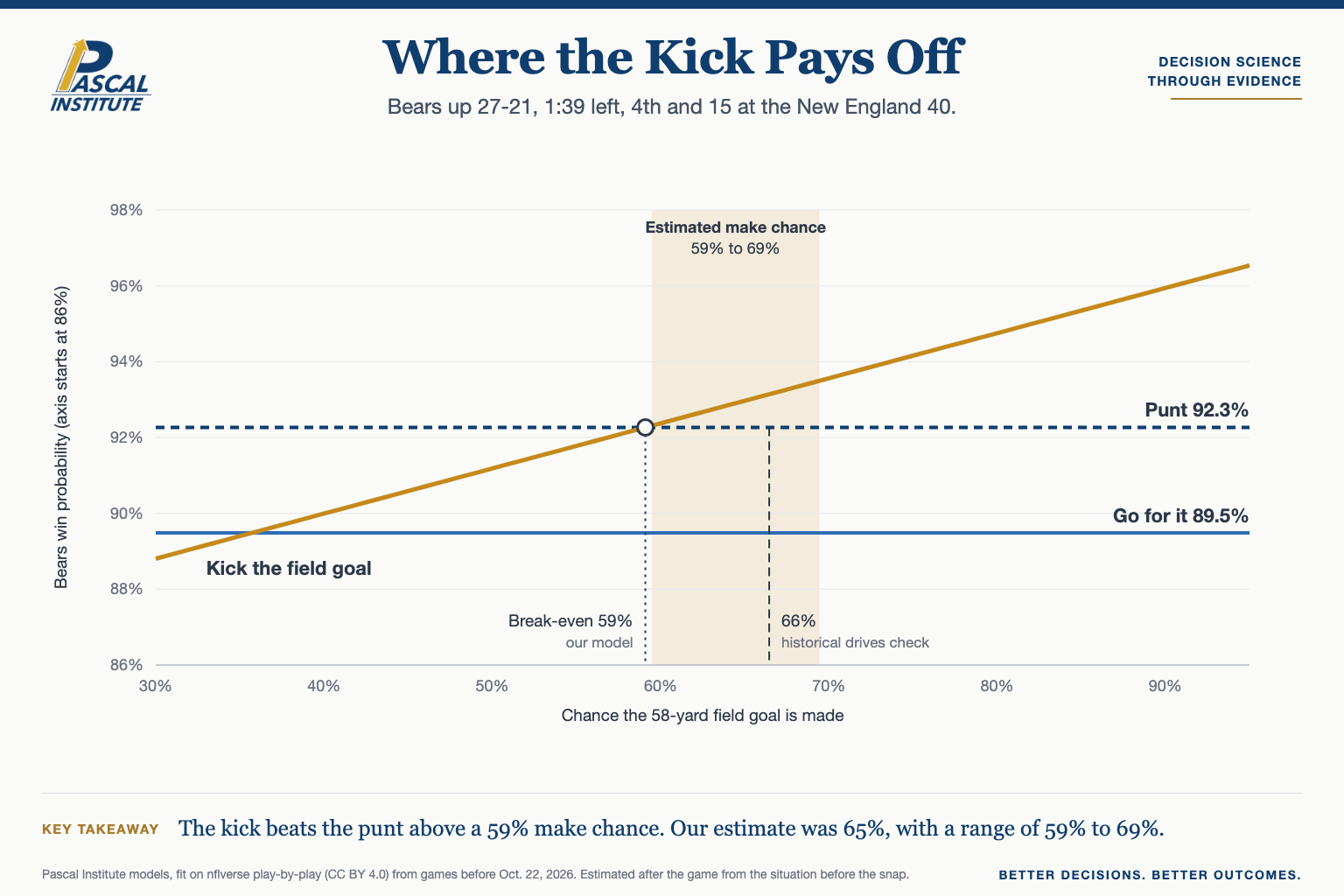
So the kick was ahead of the punt by about 0.7 points, a toss-up by our labels. That edge is not firm either. We refit the model 50 times on different samples of past games. The gap ran from -0.8 to 2.0 points across 95% of those refits, and the kick came out ahead in 66% of them. A version of the model without the betting line gave the kick a slightly larger edge, 1.1 points, with a break-even of 56%.4
A Second Look Without the Model
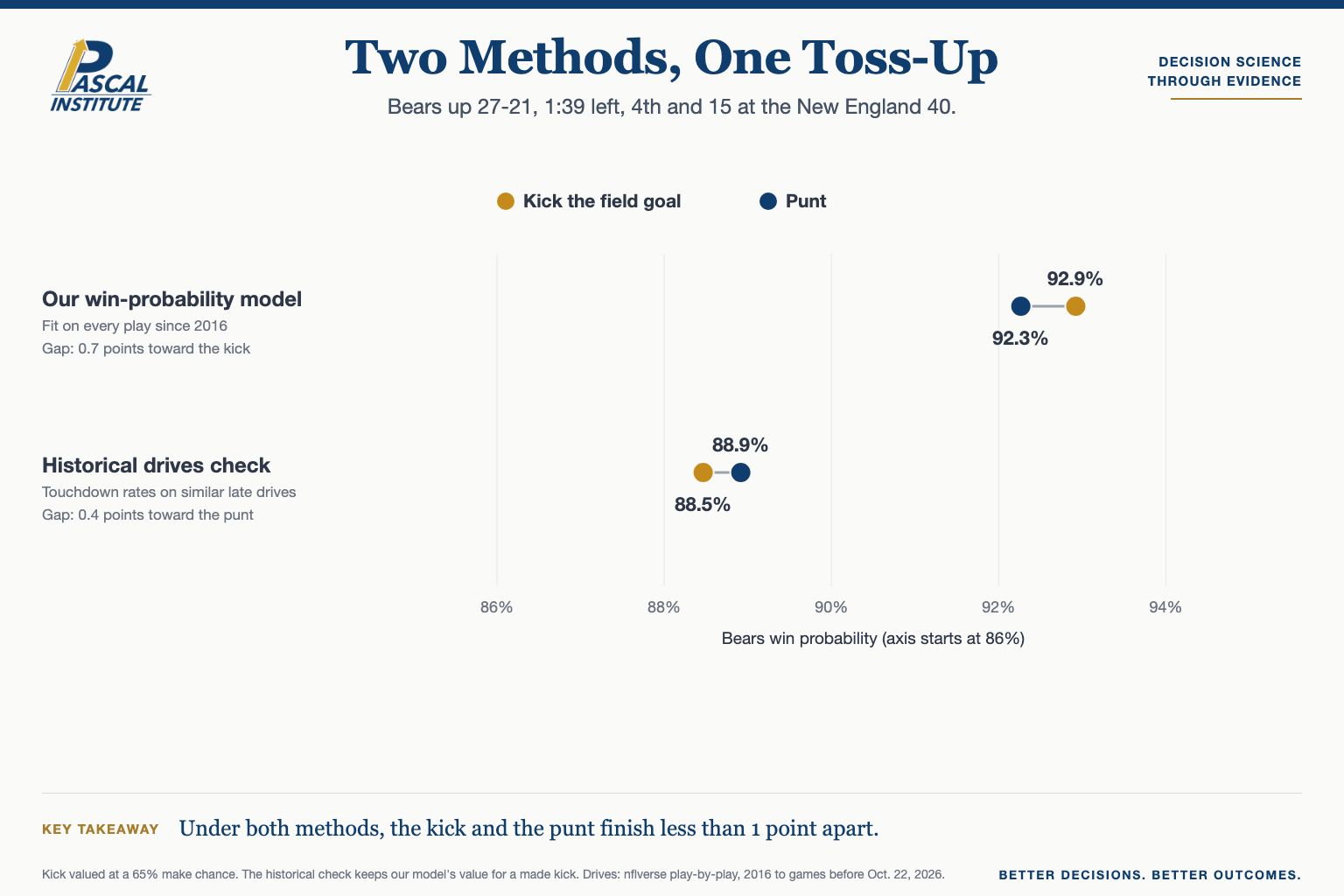
Our model is built for every situation in a game, and late drives against a defense with no timeouts are thin in its data, so we also checked the answer against what actually happened on similar drives. Since 2016, offenses that needed a touchdown and got the ball in the fourth quarter with 45 to 150 seconds left scored one on 15% of drives starting at their own 1 to 15 (10 of 67). From their own 40 to 60, they scored on 37% (21 of 57). Teams that trailed by 1 to 3 points with 15 to 60 seconds left scored on 26% of their drives (35 of 136), which is how often Chicago might have answered.4 These samples are small, so they give a rough check, not a second precise estimate.
Combining those rates gives a model-free version of the same decision, built only from what happened on past drives. It suggests a miss was more expensive than our model says. In this version, punting and kicking come out even, at 88.9% and 88.5%, and the kick needed about a 66% chance to break even. Using only drives without timeouts, the two were tied at 90.3%. The two methods disagree on which side of the line the kick fell, but both put the gap under 1 point.
What the Result Cannot Tell Us
The kick went in, and that tells us almost nothing about the call. Under our models, Chicago was choosing between two options worth nearly the same, and either a punt or a field goal was a defensible choice. A miss would not have proved the kick wrong, and the make does not prove it right. The same is true of the switch from punt to kick: our estimates cannot say whether Santos's request carried information about how he felt that night. They see his record, the distance and the weather, not his warm-up or the staff's read of him.
This is the mirror image of the Houston kick we studied in "Not All Field Goals Weigh the Same," also from 58 yards. There, a make bought too little for the kick to compete with going for it.5 Here, a make bought a little less than a miss would have cost, which set the bar above a coin flip. Our model's levels in end-game states also differ from the public nflfastR model, and the methodology page sets out those limits with the rest of the method.6 The habit worth building is to price both outcomes before the snap, which our review of Tampa Bay and Dallas argued as well.3 Readers who want to test their own calls the same way can use AnalytIQ's Decision Journal, which records a decision before the result is known and brings it back once the outcome arrives.
Notes
- nflverse, NFL play-by-play data, game 2026_07_NE_CHI, New England at Chicago, Oct. 22, 2026. Licensed CC BY 4.0.
- Courtney Cronin, "Bears' Santos gets redemption with game-sealing FG after 'annoying' miss vs. Pats", ESPN, Oct. 23, 2026.
- Pascal Institute, "One Lean, One Coin Flip".
- Pascal Institute research,
research/nfl-bears-patriots-field-goal, built from nflverse play-by-play, 2016 seasons through games before Oct. 22, 2026. See the methodology page. - Pascal Institute, "Not All Field Goals Weigh the Same".
- Pascal Institute, methodology for "A Toss-Up From 58 Yards".