
Decision analysis · Expected value
Turning a Fourth-Down Call into an Expected-Value Question
This case study retells research that Pascal Institute has published, with links to the full articles and their methods below. It is not a client engagement.
The decision
On September 20, 2026, the Houston Texans trailed Cincinnati 10-3 and faced fourth-and-one at the Cincinnati 40 in the third quarter. They could punt, go for the first down, or try a 58-yard field goal. A week earlier their kicker had made a 58-yarder to take the lead against Buffalo, and the head coach pointed to that kick. Houston kicked, and the attempt came up short. Our article asked whether the kick was the right choice before anyone knew the result.
What success buys
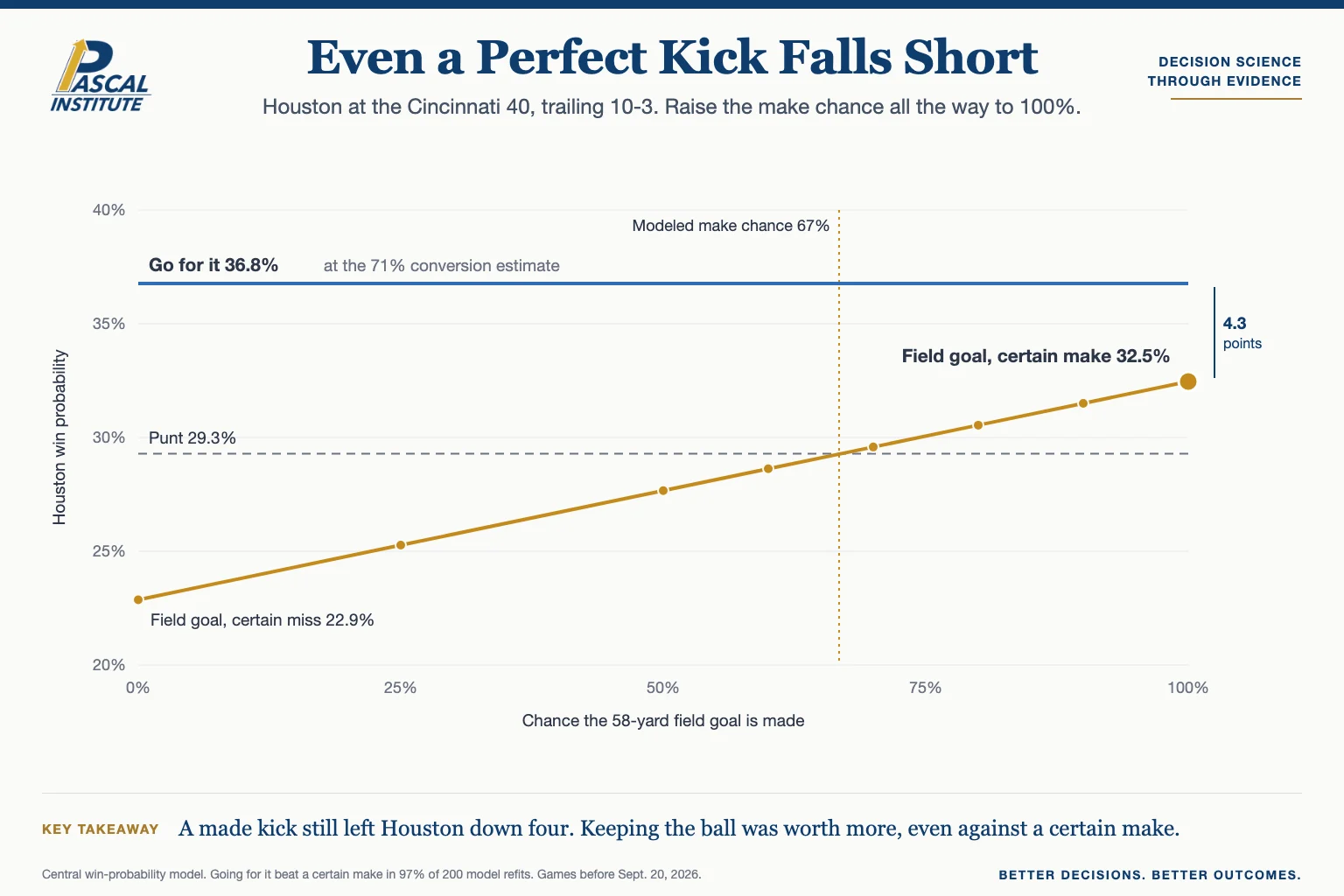
We set the outcome aside by giving Houston the result it wanted. Our distance model, which accounted for the closed roof, put the chance of a make near 67 percent. A made kick would have left Houston trailing 10-6 and still needing a touchdown, and our win-probability model put Houston’s chances after a make at about 32.5 percent. Going for it, at a modeled conversion probability of about 71 percent, was worth about 36.8 percent. Even a certain make was worth less than going for it, and that held in 97 percent of 200 refits of the win-probability model.
The same 58-yard kick had been worth about 25 points of win probability against Buffalo and about 10 against Cincinnati. The kick was the same; the score changed what a make bought.
Finding the boundary
The most useful number was the break-even point: the conversion probability at which going for it ties the best kicking option. At the Cincinnati 40 it was about 28 percent, far below the estimated 71 percent, so the decision was robust to reasonable errors in the estimates. Houston’s earlier fourth-and-one at the Cincinnati 18, in a tie game, had a central break-even of 52 percent, and 95 percent of refits put it between about 29 and 69 percent. That was a much closer call, and it deserved more caution even though the conversion estimates were similar.
Our first analysis suggested that field position explained the difference. Further checks showed that only the score effect was consistent, and the article reports that correction. The same break-even arithmetic, C divided by V plus C, appears in our ABS research and applies to any choice where gain and loss can be valued on one scale.
What this means for your organization
Organizations spend real effort refining forecasts without asking whether a better forecast would change the decision. Moving an estimate from 71 to 73 percent does not matter when the threshold is 28 percent, while moving it from 69 to 71 percent may matter a great deal when the threshold is 70. We help teams define what success and failure are worth, compare the real alternatives, find where the preferred choice changes, and decide where better information is worth paying for. We also help them record the reasoning before the outcome, so a miss can be investigated rather than simply blamed.